
Revenge Trading: How to Spot Patterns in a Journal
HybridTrader Editorial

Revenge trading is an emotionally driven attempt to recover a loss quickly, typically involving unplanned entries, increased trade frequency, changed position sizing, or abandoned risk rules. It's often invisible to the trader in the moment. The trading journal is a diagnostic tool: by reviewing past trades with specific markers in mind, traders can spot this pattern objectively and build a checkpoint system to interrupt it before the next loss.
Recognizing revenge trading requires stepping back from the trade itself and examining the sequence of decisions around it. A single impulsive trade isn't proof of a pattern; a repeated association between significant losses and subsequent trades that break normal discipline is the signal to investigate.
Quick answer: Spotting the emotional cycle in your records
Revenge trading leaves measurable traces in a trading journal: a spike in the number of trades taken shortly after a loss, position sizes larger than standard risk per trade, and entries missing usual planning criteria. When these markers cluster together, especially after a loss exceeding typical single-trade thresholds, they warrant structured review.
Journaling alone doesn't eliminate revenge trading. What matters is whether you use that data to interrupt the pattern before it compounds losses.
What the behaviour may look like
Revenge trading typically manifests in observable ways within trading activity:
Trade frequency jumps. A trader who normally takes 2-4 trades per session suddenly places 8-10 trades within hours of a significant loss.
Position sizing grows. Trades entered at 2-3% risk when the standard is 1%, or with "all-in" sizing, in an attempt to recoup losses faster.
Planning disappears. Journal entries lack a coherent trade plan, entry rationale, or defined exit criteria. Notes may read "just felt it," "chased the bounce," or show missing fields that are normally completed.
Instrument or market shift. A trader deviates from proven focus, for example, an FX specialist suddenly trading penny stocks, reflecting a desperate search for "easier" profits.
Emotional language in notes. Angry, frustrated, or urgent tone in journal observations, especially surrounding losing trades.
These are observations, not diagnoses. One jump in size after a loss doesn't confirm revenge trading; a repeated association between losses and these behaviors does.
What evidence a journal can record
An AI trading journal can capture objective data that may point to revenge trading:
Trade count by session. Record daily trade frequency and flag sessions with counts well above your average.
Position size per trade. Log the % risk or contract size for every entry. Compare post-loss trades to typical discipline.
Entry criteria met or missed. Create a simple column: "Plan followed: Yes/No." Missing data here after losses is itself evidence.
Time stamps. Note the clock time of entry. If most trades cluster in the hour after a large stop-loss hit, that's a pattern worth examining.
Notes field. Record why you entered: "Setup matched pattern X," "impulse," "trying to recover," or "chasing." Neutral language when disciplined, urgent language when emotional.
HybridTrader supports automatic syncing for compatible connections, while other trading histories can be imported by CSV. Traders can check the current list of supported brokers and platforms or follow the CSV import guide.
The journal can't establish why a trader felt compelled to trade; it only shows that the behaviour changed in a measurable way. That distinction matters.
What the data cannot explain
A spike in trade frequency after a loss doesn't prove emotional motivation. Market conditions might have genuinely improved, creating more legitimate setups. Position sizing might have changed due to an intentional plan adjustment.
Reduced planning notes might reflect faster decision-making rather than abandoned rules.
The journal shows association, not causation. Your interpretation of that data depends on context: your strategy, typical market environment, and honest assessment of whether the change served your trading plan or deviated from it.
Missing or inconsistent journal records distort analysis. If you skip entries on losing days or record less detail when frustrated, the pattern will be incomplete. Spotty journaling also makes it harder to distinguish between an isolated bad trade and a true behavioral cycle.
How to review repeated occurrences
To identify a true pattern rather than a single lapse:
- Filter your journal for losing trades exceeding your personal loss threshold (e.g., 1-2% account loss per trade, or days totaling >3% drawdown).
- Look at the next 3-5 trades chronologically after each significant loss. Record frequency, size, planning quality, and any emotional notes.
- Compare these post-loss trades to your baseline. What do your disciplined trades look like? Tally how many post-loss trades deviate from that baseline.
- Count the repetitions. If this pattern appears in 5+ instances across your journal, it's worth treating as a behavioral cycle, not random variance.
A pattern emerges when the same markers cluster repeatedly in the same sequence: loss → frequency spike, size increase, missing planning. One instance may be coincidence; three or more suggest habit.
Questions to ask after the trade
After every trade, especially after a loss, reflect on these points:
Did I enter this trade because it matched my predefined setup, or because I felt the need to recover?
Is my position size consistent with my risk rule, or did I increase it?
Can I clearly state my entry and exit plan in my journal, or is it vague?
How much time passed between my last loss and this entry?
What does my typical trade look like compared to this one?
Write these answers into your journal. This forces a pause between emotion and action, and it builds a record you can later review objectively.
Practical review checklist
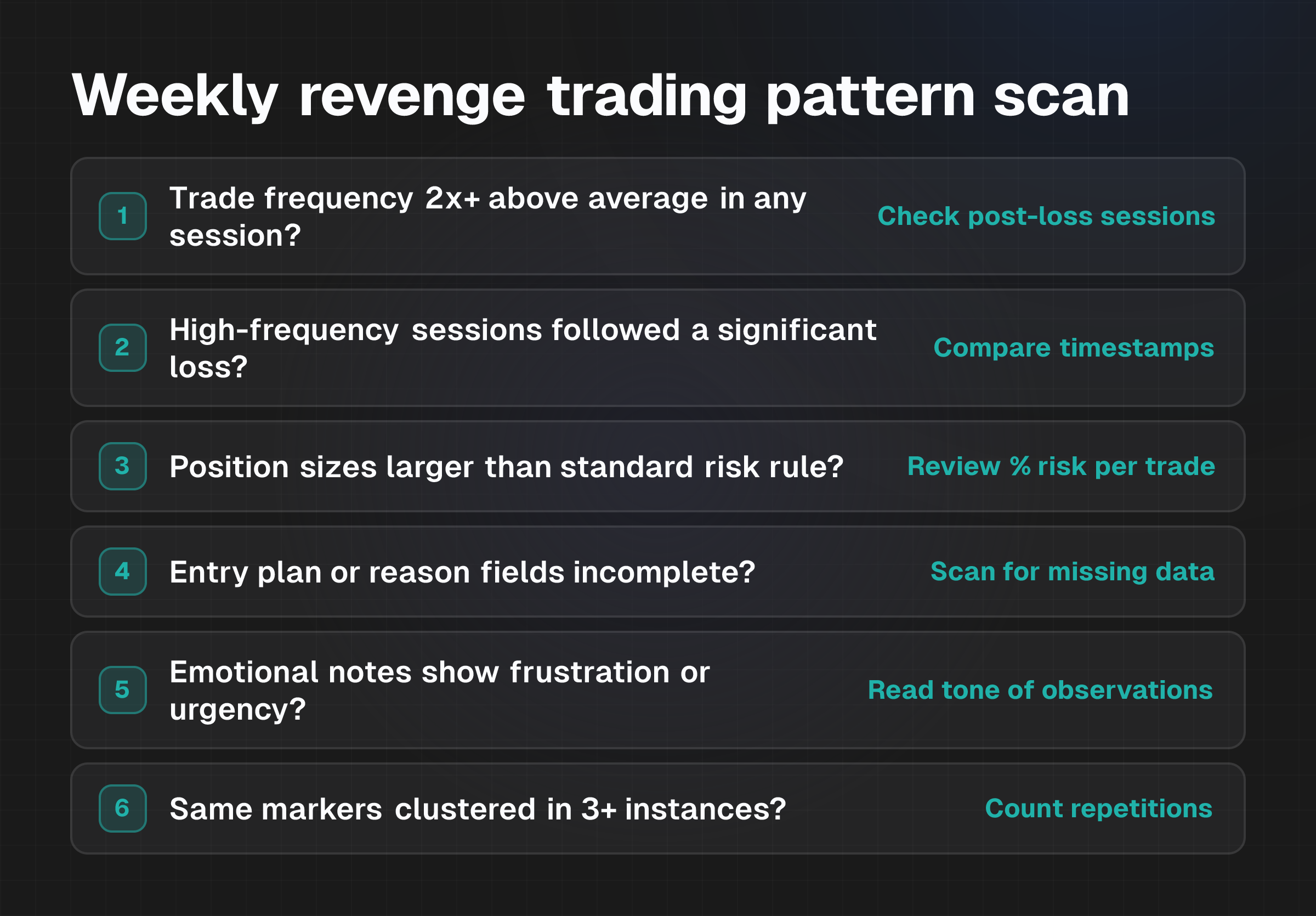
Use this checklist weekly to scan for revenge trading patterns:
- Did any session show trade frequency substantially above the trader's normal average?
- Did the unusually active session follow a significant loss?
- Were position sizes larger than the trader's documented standard?
- Were "Entry reason" or "Plan" fields incomplete for these trades?
- Did the emotional notes, if recorded, show frustration, urgency, or an attempt to recover?
- Did the same cluster of markers appear across multiple independent sessions?
- After identifying a possible pattern, was a clearly defined post-loss checkpoint tested?
If more than half of these items apply, a structured checkpoint is worth testing.
Limitations
Journaling is a diagnostic tool, not a cure. Recording a revenge trade doesn't prevent the next one; what matters is whether you use the data to change your pre-trade decision point. Many traders identify the pattern in their journal but continue the behavior because they lack a concrete interrupt mechanism.
A single session or a single trade can't confirm a pattern. Behavioral changes in trading deserve repeated observation before you draw a conclusion.
An external factor, genuine market opportunity, a change in strategy, or news-driven volatility, can coincide with post-loss trading and create a false association. Your journal helps you notice the correlation; you must still apply judgment to interpret it.
Further product and account information is available in the HybridTrader FAQ.
Next step: Build a checkpoint before the next loss
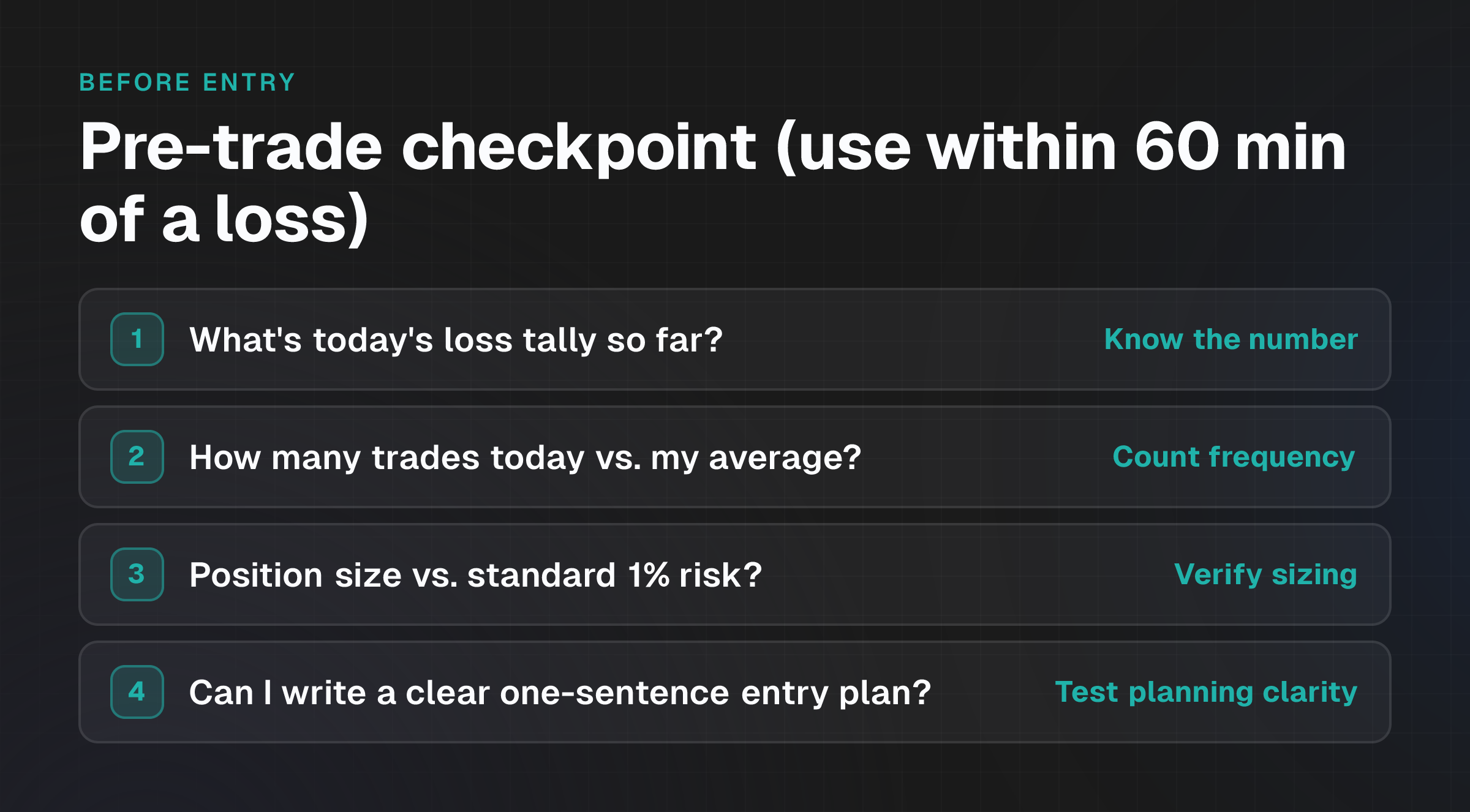
The most practical intervention is a pre-trade checklist anchored to your journal data. Before any trade, especially within 60 minutes of a loss, force yourself to answer:
- What's today's loss tally so far?
- How many trades have I taken today? Is it above my average?
- What's my current position size versus my standard 1%?
- Can I write a clear one-sentence entry plan?
If any answer signals a deviation from your normal discipline, delay the trade by 30 minutes and revisit the checklist. This creates a human-controlled checkpoint between impulse and execution.
FAQs
Is one impulsive trade after a loss proof of revenge trading?
No. A single unplanned trade can result from market opportunity, distraction, or a one-off lapse in discipline. Revenge trading is a pattern, a repeated association between losses and trades that break your standard position sizing, frequency, or planning rules. Look for at least 3-5 repeated instances across your journal before concluding it's a behavioral cycle.
How do I separate a legitimate setup from a revenge trade if they look similar?
Compare the trade to your baseline discipline: Does it match your predefined entry criteria? Is the position size within your standard risk rule? Did you plan it before the loss, or enter it afterward? A revenge trade typically arrives with minimal planning and enlarged position sizing. A legitimate setup follows your process regardless of recent losses. Your journal should capture enough detail to answer this.
Can I use emotional language in my journal as evidence of revenge trading?
Emotional notes are honest self-reporting, but they're subjective. Frustration or urgency around a trade doesn't prove it was driven by revenge; it's one data point. Pair emotional observations with objective metrics, frequency, size, planning gaps, to build a stronger case. The combination is more reliable than either alone.
What should I do if I identify a revenge trading pattern in past trades?
First, acknowledge the pattern in your journal: list the dates and the markers that repeat. Next, design a concrete checkpoint: for example, a mandatory 30-minute cooldown after any loss exceeding 1%, or a pre-trade checklist you must complete before entry. Test this checkpoint for 2-4 weeks. Record whether it reduced the frequency of post-loss trades. Adjust as needed based on what actually works for your workflow.
Does using a trading journal guarantee I will stop revenge trading?
No. A journal is a diagnostic tool; it shows you the pattern but doesn't enforce behavioral change. What matters is whether you build a checkpoint system around the data and apply it consistently before the next trade. Journaling without action is observation without intervention.
How often should I review my journal for revenge trading patterns?
Review weekly, especially after significant losses or high-frequency trading sessions. Look for the markers in the preceding 5-10 trades. A monthly deep review of the entire month's data can also reveal patterns you might miss in smaller windows. Consistency in review builds the habit of self-checking before the next loss cycle begins.