
Stop Bad Trading Habits: Review Decisions With Real Data
HybridTrader Editorial

Traders often track profit and loss but skip the harder work: reviewing the decisions that led to those outcomes. A winning trade can follow poor judgment, and a losing trade can result from sound process. Systematic review of recorded trades reveals patterns in decision-making, separates one-time events from repeated behaviour, and helps distinguish between correlation and causation, the gap between two things occurring together and one actually driving the other. This guide structures that review around recorded evidence, reflection, and practical checklists.
Quick answer: Recording decisions separately from results
Capturing trade data systematically, entry and exit prices, rationale, market context, and emotional state, allows a trader to evaluate decision quality independent of P&L. The journal shows what happened and what the trader perceived at the time; it can't establish why a pattern occurred or guarantee that addressing it will improve future outcomes. A repeated association between a behaviour and an outcome is evidence worth investigating, not proof of causation.
What the behaviour may look like
Decision patterns emerge across multiple trades and often repeat under similar conditions.
Common observations include entering trades before a written plan is confirmed, or abandoning a plan mid-trade without documented reason. Some traders exit winning positions with small profits while holding losers longer, or vice versa. Others place trades during high emotional arousal, frustration, overconfidence, fear, versus calm deliberation.
Trading without stop-losses or with position sizes that exceed a stated risk limit appears frequently in journal reviews. Clustering trades on specific days or times shows up, too. So does increasing trade frequency after a loss.
None of these observations alone indicates a problem. The question is whether they repeat across a meaningful sample of trades and whether the trader recognizes them as deviations from intention.
What evidence a journal can record
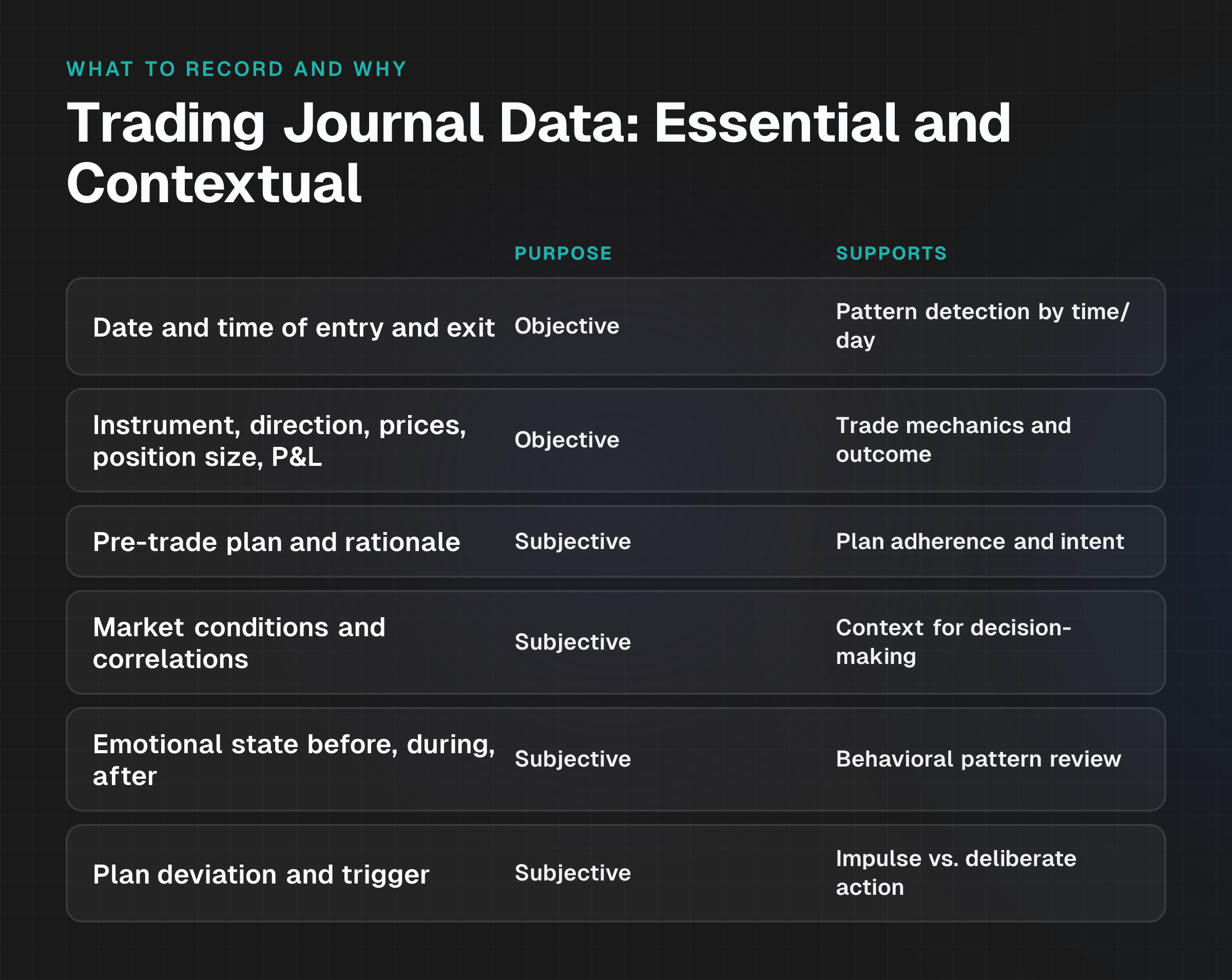
A comprehensive trading record captures both objective and subjective data.
Minimum required data:
- Date and time of entry and exit
- Instrument traded
- Direction (long or short)
- Entry price, exit price, position size
- Realized profit or loss
Contextual data that supports pattern review:
- Pre-trade plan: what conditions needed to be met before entry
- Rationale: why the trade was placed
- Market conditions: perceived technical setup, news events, multi-asset correlations
- Emotional state before, during, and after the trade
- Whether the trade followed the written plan or deviated, and if so, what triggered deviation
Research published by Shiv, Loewenstein, Bechara, Damasio, and Damasio (2005) in Psychological Science found that individuals with emotional impairments made more rational financial decisions than healthy individuals prone to emotional biases. This suggests that emotional arousal often accompanies suboptimal decision-making, making emotional self-reporting in a journal a useful starting point for review, not a diagnosis, but honest information about the trader's state during the trade.
Recording emotional state is subjective. A trader might note "calm," "confident," "frustrated," or "uncertain" before entering a trade. The journal shows the association between stated emotion and recorded action; it doesn't prove that the emotion caused the decision.
What the data cannot explain
The journal documents what happened and what the trader believed at the time. It can't establish causation or predict future outcomes.
Market context can't be made predictable. Macroeconomic events, news releases, technical breakdowns, and correlations across multiple assets influence trade outcomes. The journal can record the perceived conditions surrounding a trade; it can't make an individual trade predictable or explain why it succeeded or failed with certainty.
Emotional states are subjective reports. A trader's stated emotional state is honest self-reporting, but it's not a diagnosis and doesn't prove that emotion caused the decision. Recording "felt overconfident before this trade" and "this trade lost money" doesn't prove overconfidence caused the loss. Multiple factors, market timing, position sizing, stop-loss placement, news events, influence outcome.
Association isn't causation. Research by Kahneman and Tversky (1979) on Prospect Theory, published in Econometrica, highlights cognitive biases that can lead to decisions that aren't purely rational. The research shows that certain decision-making processes correlate with suboptimal outcomes in laboratory settings. In real-world trading, a repeated association between an action (e.g., trading without a stop-loss) and an outcome (e.g., large losses) is worth reviewing, but proving direct causation requires controlled experimental conditions often not available in live markets.
Hindsight isn't foresight. Knowing an outcome after the fact doesn't mean it was predictable beforehand. A trader may review a losing trade and identify what "should" have been done, confusing the clarity of hindsight with the uncertainty that existed during the trade.
How to review repeated occurrences
Distinguishing a one-time event from a repeated behaviour requires counting and context.
Define the behaviour clearly. For example: "entering a trade without a pre-written plan" or "exiting a winning trade before hitting the target" or "increasing position size after a losing trade."
Count occurrences across a significant sample. A single instance may be an anomaly. Multiple instances across at least 10-20 trades (or more, depending on trade frequency) suggest a pattern. The threshold depends on how often a trader trades; a day trader with 50 trades per week has more data points than a swing trader with 4 trades per week.
Record the context. Did the behaviour occur across different instruments, market conditions, and time of day, or only under specific circumstances? A trader might consistently exit winners early only when trading a volatile instrument, or only after a series of losses.
Separate the pattern from a single outlier. If a trader exited early on one trade due to unexpected news, that's a one-time event. If the trader exited early on 12 of the last 30 trades, that's a repeated behaviour worth reviewing.
Check consistency in the record. Incomplete or inconsistent journal entries render analysis unreliable. If emotional state is recorded for some trades but not others, or if rationale is missing from half the records, the sample is compromised.
Questions to ask after the trade
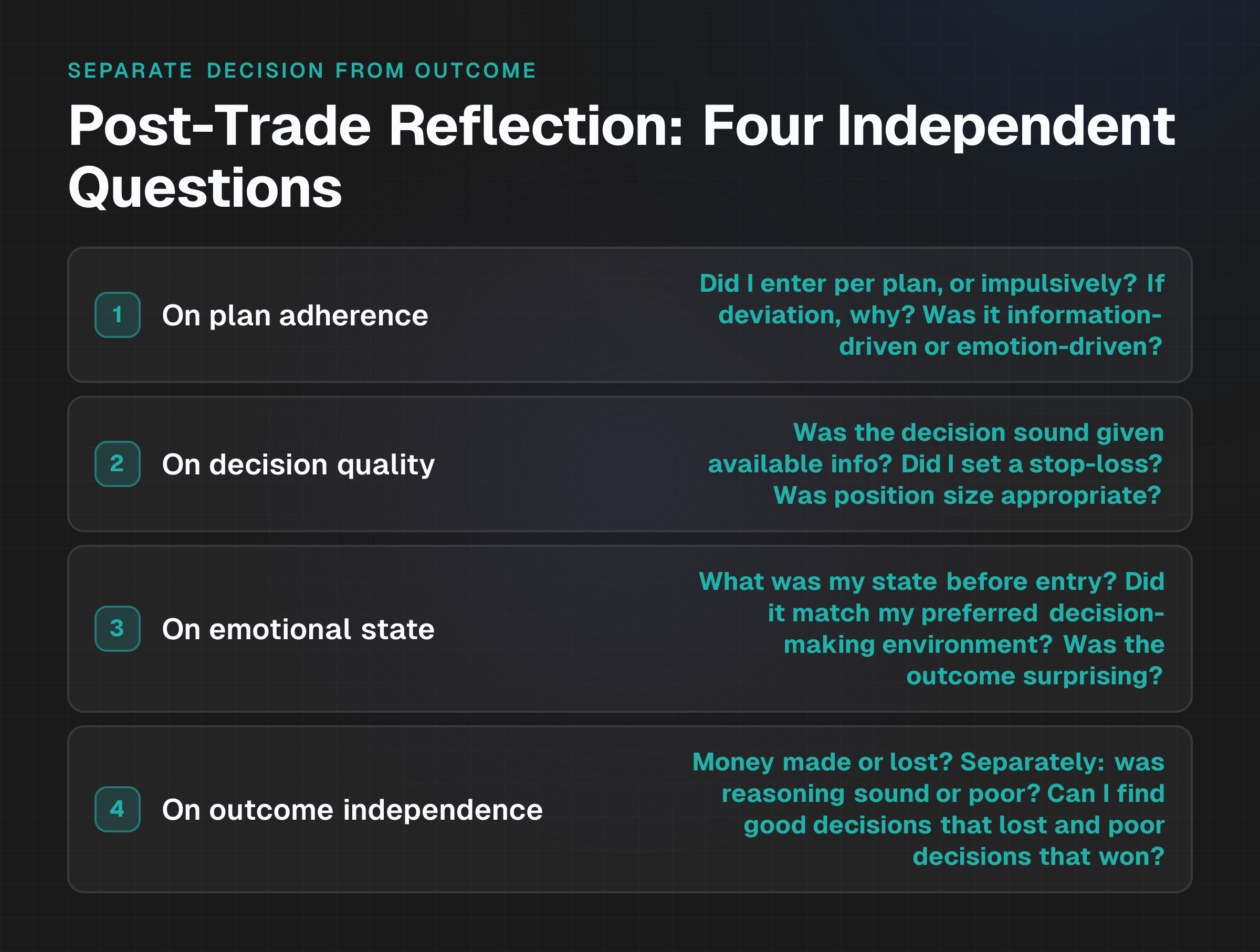
Effective post-trade reflection follows a structured approach.
On plan adherence:
- Did the trader enter this trade according to a pre-written plan, or was it an impulse entry?
- If the plan was deviated from, what triggered the deviation?
- Was the deviation justified by new market information, or was it driven by emotion?
On decision quality:
- Given the information available at the time of entry, was the decision sound?
- Did the trader set and respect a stop-loss before entry?
- Was position size appropriate for the account risk tolerance?
On emotional state:
- What was the trader's emotional state before entering this trade?
- Did that state match the trader's preferred decision-making environment?
- After the trade closed, did the outcome feel surprising, expected, or frustrating?
On outcome independence:
- Did this trade make money or lose money?
- Separately: was the decision well-reasoned or poorly-reasoned?
- Can the trader identify cases where a good decision produced a loss, or a poor decision produced a gain?
These questions treat the trade and the decision as separate subjects. A losing trade doesn't mean the decision was wrong; a winning trade doesn't validate the process.
Practical review checklist
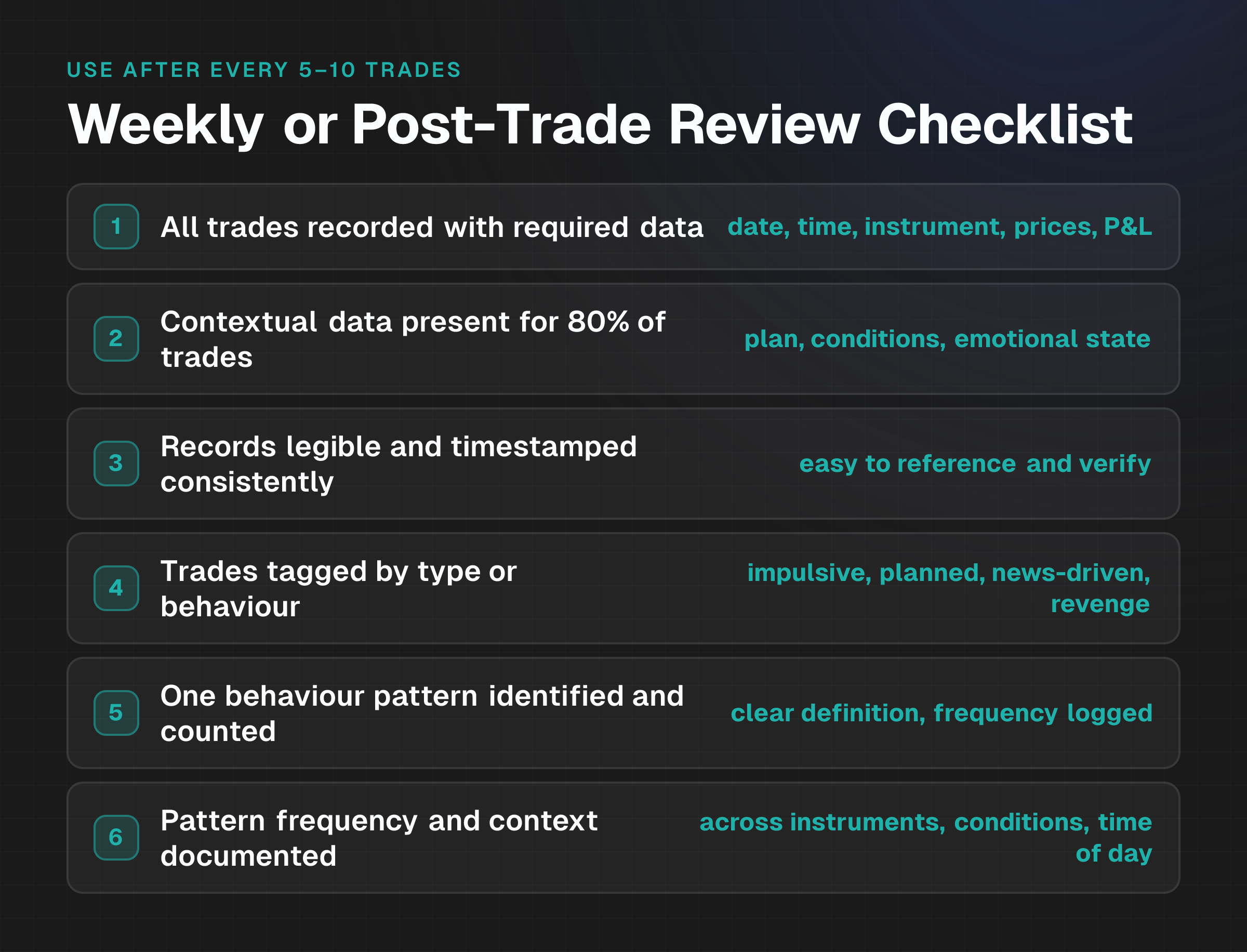
Use this checklist weekly or after every 5-10 trades:
- All trades from the period are recorded with required data (date, time, instrument, entry price, exit price, P&L)
- Contextual data is present for at least 80% of trades (pre-trade plan, market conditions, emotional state)
- Records are legible and timestamped consistently
- Trades are tagged or grouped by type (e.g., "impulsive entry," "followed plan," "news-driven," "revenge trade")
- One specific behaviour pattern has been identified and counted across the sample
- The frequency and context of that pattern have been documented
- The pattern has been cross-checked against the underlying trade records
- A distinction has been made between one-time events and repeated behaviour
- Decision quality has been evaluated separately from P&L
- The review has noted what remains uncertain or unclear in the records
Limitations
Systematic review has real constraints.
Incomplete or inconsistent records distort analysis. If a trader records emotional state on some trades but not others, or provides rationale for entries but not exits, the sample is biased. Analysis is only as reliable as the data underlying it.
Confirmation bias influences interpretation. A trader may seek out data that confirms existing beliefs about trading style rather than challenging them. The review process requires honest engagement with evidence that contradicts the trader's self-perception.
Over-analysis can delay action. Spending excessive time reviewing past trades can become a substitute for executing new trades. The goal is to extract actionable insights, not to achieve perfect clarity before the next trade.
Behavioral insight doesn't guarantee improved performance. Identifying a repeated behaviour, such as exiting winners too early, is useful information. Addressing it is a separate step, and changing behaviour is difficult even when a trader recognizes the pattern. Neither identifying nor correcting a behaviour guarantees improved profitability or a higher win rate.
Tools can't determine causation for the trader. Some platforms offer automated analysis that flags deviations from a plan or emotional patterns. These tools can display correlations in recorded data, for example, that trades entered during high emotional arousal tend to close with smaller profits. They can't prove that emotion caused the smaller profit, only that the association appeared in the data.
Next step
The first practical step is to select one behaviour pattern to track across the next 10-20 trades.
Rather than attempting to review all decisions at once, focus on a single question: Does the trader consistently exit winning trades before the target? Does position size increase after losses? Are trades entered without a written plan?
Record the required data for each trade, tag or note instances of the target behaviour, and count them at the end of the period. Then cross-check the tagged trades against the underlying records to confirm the pattern is real and not a result of selective memory.
Journaling doesn't replace a documented trading strategy, risk controls, or personal responsibility for trade execution. It's a tool for observing decision patterns and creating a factual record to review against. The value lies in the habit of deliberate reflection, not in the tool itself.
FAQs
What if trading happens only a few times per month? Is more data needed to spot a pattern?
Yes. If a trader executes only 4-8 trades per month, a pattern of 2 or 3 occurrences isn't yet reliable evidence. Aim for at least 15-20 trades before drawing conclusions. With fewer trades, natural variation in outcomes is harder to distinguish from actual behaviour.
Can profit and loss alone spot a behaviour problem?
Not reliably. A trader might have a higher win rate but smaller average winners, or a lower win rate but larger winners. Focusing only on P&L misses the decision quality underneath. A losing trade can follow a sound decision, and a winning trade can result from poor reasoning. Review the decisions, not just the results.
Should emotional state be recorded before or after the trade closes?
Record it before and during. Pre-trade emotional state shows the trader's condition when making the entry decision. Post-trade emotional state, relief, frustration, satisfaction, is useful context but doesn't explain the decision. The goal is to document the conditions when choices were made, not to reinterpret them after the outcome is known.
What if journal records show a pattern, but the fix isn't obvious?
Identifying a pattern is the first step. Understanding causation is often impossible with individual trade data alone. A next step is to decide: Does this pattern matter enough to change, or is it simply how the trader operates? If change is desired, the focus shifts from analysis to execution, practice entering trades on plan, or use a mechanical stop-loss that removes discretion. Journaling doesn't make change automatic; it creates awareness.
Is a tool like HybridTrader necessary to spot patterns, or can a spreadsheet work?
The comparison depends on recording habits, required integrations, data controls, and preferred workflow. A spreadsheet requires manual data entry but offers full control and is free. A dedicated journaling tool may sync directly with a trading account to import fills automatically, reducing manual work and error. The useful question isn't which tool sounds more advanced, but which workflow a trader can maintain consistently.
If impulsive trading happens more often after losses, does that mean revenge trading is causing the losses?
No. The journal shows that impulsive trading and losses occur together in recorded data; it doesn't prove one caused the other. A trader might trade more impulsively after losses because frustration lowers decision discipline, or because losses exhaust the trading day and the trader makes tired decisions, or because market conditions were poor both when the initial loss occurred and when the impulsive trade was entered. A repeated association is evidence worth investigating, not proof of causation.