
Can AI Trading Journals Predict Future Performance
- HybridTrader Editorial
An AI trading journal can help traders understand why they've been profitable or unprofitable in the past by identifying patterns in behavior and their association with trade outcomes. It highlights habits that cost money and shows what market conditions trades have faced. However, it cannot reliably predict whether a trader will be profitable tomorrow. Markets shift constantly, and past patterns aren't guarantees of future results. The primary value lies in enhanced self-awareness and a structured approach to learning from historical performance, not in forecasting future trade success.
This distinction matters because traders often expect AI tools to predict the next winning trade or guarantee improved returns. That expectation conflicts with what historical data can actually reveal. The journal records what happened. It doesn't determine what will happen.
Quick answer: Historical patterns reveal behavior, not destiny
An AI trading journal cannot forecast tomorrow's profitability because markets change, conditions vary, and past association isn't proof of future cause.
A repeated pattern in closed trades, such as losses clustering on Mondays or after certain market events, is evidence worth reviewing, not proof that the pattern will repeat. A losing trade can follow a sound process, while a winning trade can result from a poor decision. The journal can show that a pattern appeared in recorded trades; it cannot establish with certainty why it occurred or guarantee it will happen again.
The core benefit of an AI journal is improved self-awareness, not improved forecasting accuracy. It reveals habits and decision patterns, which traders can then choose to examine or modify. That requires human reflection and discipline, not just algorithmic analysis.
What the behaviour may look like: Pattern correlation mistaken for prediction
Traders see a repeated association and treat it as a causal rule.
It happens constantly.
Consider these examples: Trades taken on Mondays show more losses than trades on other days, so the trader concludes Mondays are "bad trading days" and avoids them. Winning trades often occur after premarket research, so the trader assumes extra research always improves outcomes. Losses spike after emotional tags recorded in the journal, so the trader believes the emotion caused the loss, not the decision itself.
Each of these observations is a correlation, two things appearing together in the historical record. None of them is causation, proof that one thing directly caused the other. The journal can identify the pattern; distinguishing between coincidence and cause requires deeper review of the underlying trades, market conditions, and decision logic.
An AI system can recognize that a pattern appeared across multiple trades. It cannot read the psychology behind trades, the market volatility that traders couldn't anticipate at entry, or the quality of the original decision independent of its outcome.
What evidence a journal can record: Observable trade metrics and context
An AI trading journal records structured, verifiable data about closed trades.
Entry and exit points, order size, commission and slippage costs. Date, time, and market conditions at the time of the trade. Trader-supplied tags or notes about plan adherence, emotional state, or rationale. External market context, such as economic events or macro signals present on the trade date. Repeated behaviors across multiple sessions, such as overtrading after losses, consistent time-of-day patterns, or recurring trade setups.
For example, an AI journal can detect that a trader's average loss is larger on days when three or more trades are taken, compared to days with one or two trades. This is a measurable association. What the journal cannot record is whether the trader was aware of overtrading, whether market volatility increased on those days, or whether the trader's decision-making process degraded under pressure. Those require manual review of the trades themselves.
The quality and consistency of recorded data directly affects the reliability of any pattern identification. Incomplete notes, missing emotional tags, or inconsistent categorization of trades will distort the analysis.
What the data cannot explain: The gap between pattern and cause
Historical trade data has inherent limits.
An AI system analyzing a journal can identify which patterns appeared in past trades, which market conditions or behaviors correlate with losses or wins, which habits repeat across multiple sessions.
It cannot reliably establish:
Why the pattern occurred. A pattern of losses after high-volatility days could reflect the trader's strategy being unsuited to that volatility, external factors beyond the trader's control, or the trader's risk management failing under pressure. The journal shows the association; it doesn't prove the cause.
Whether the pattern will repeat. Market conditions change. A setup that worked in a rising trend may fail in a range-bound market. Past association doesn't guarantee future recurrence.
What the trader was thinking at the time of entry. Even if notes are recorded, they reflect memory and post-hoc rationalization, not the actual decision logic in the moment.
Whether a winning trade validates the decision. A trade can succeed for reasons unrelated to the process used to enter it. A sound decision can lose money; a poor decision can win. Outcome and decision quality are separate measures.
Current AI journal systems don't distinguish reliably between patterns that truly impact profitability versus those that are merely coincidental. This remains a gap in capability.
Market context can support review, understanding that a trade was taken before an economic announcement, for instance, but it cannot make an individual trade predictable. The journal is a tool for reflection, not a forecast engine.
How to review repeated occurrences: Building evidence across sessions
A single trade tells you very little. A pattern requires multiple instances across different sessions.
To review whether a repeated behavior is worth investigating further:
Define the pattern clearly. Instead of "Monday trades are bad," specify: Of Monday trades over the last three months, what percentage lost money? How did the average loss compare to other days?
Check for sufficient sample size. A pattern based on two or three trades isn't yet reliable evidence. Review at least 10-15 instances of the behavior before drawing conclusions.
Isolate the variable. If losses cluster after certain market events, separate trades taken immediately after the event from trades taken later. Did market conditions change? Did entry criteria change?
Compare decision quality to outcome. For winning trades in the pattern, review whether the entry logic was sound or whether the win was partly luck. For losing trades, ask whether the decision process was flawed or whether the loss followed a reasonable trade setup that simply didn't work.
Check for missing data. If journal tags are incomplete, or if emotional state is recorded only on losing trades, the pattern seen may be an artifact of what was chosen to be recorded, not a genuine behavioral pattern.
Once a pattern is confirmed across a meaningful sample, the next step is review, not prediction. The pattern suggests where to focus attention in decision-making or plan adherence.
Questions to ask after the trade: Separating observation from cause
After reviewing trades that appear to fit a pattern, use these reflection questions to avoid mistaking correlation for causation:
What was the entry decision? Can it be explained without reference to the outcome? Was it based on the plan, or a deviation?
What market conditions were present? Did volatility, volume, or other factors change after entry? Were those factors visible at entry time?
What was the trader trying to achieve? If chasing a loss from an earlier trade, or reacting to a missed opportunity, the pattern may reflect emotional decision-making, not market conditions.
Did the trader follow risk rules? If losses are larger after certain events, was that because stops were wider, or because positions were added to losing trades?
Can anyone identify why this pattern appeared? If no one can articulate a reason, the pattern may be coincidental.
Would this pattern hold in a different market regime? If the pattern relied on specific conditions (e.g., a rising trend or low volatility), will it apply when conditions change?
These questions move reflection beyond observation toward genuine understanding. They also reveal whether the pattern reflects a decision-making habit that can be influenced, or whether it reflects external market factors beyond anyone's control.
Practical review checklist: A structured approach to pattern review
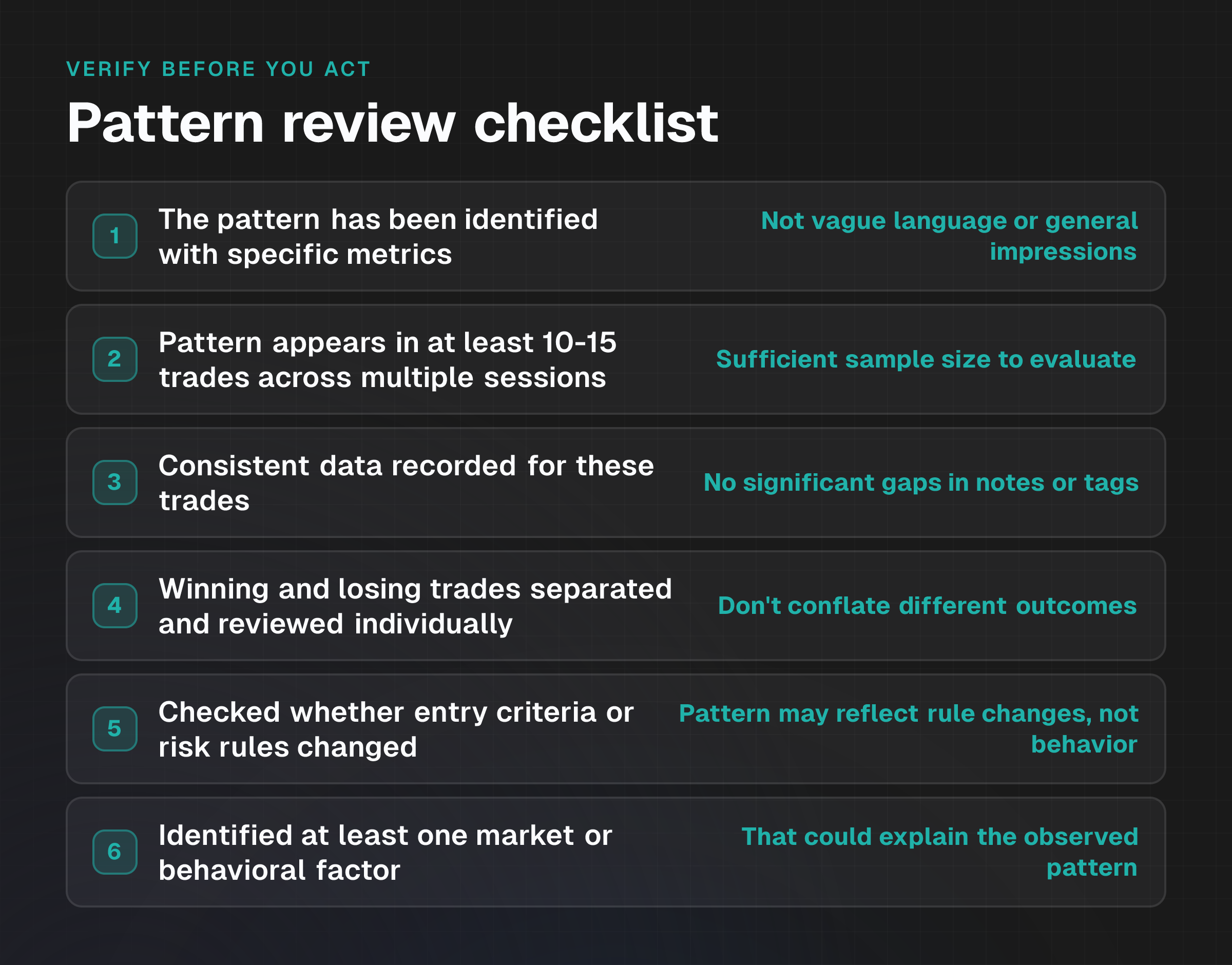
Use this checklist to evaluate a behavior or outcome pattern identified in a journal:
- The pattern has been identified with specific metrics (not vague language)
- The pattern appears in at least 10-15 trades across multiple sessions
- Consistent data has been recorded for these trades (no significant gaps in notes or tags)
- Winning trades and losing trades in this pattern have been separated and reviewed separately
- It's been checked whether entry criteria or risk rules changed during this period
- At least one market or behavioral factor that could explain the pattern has been identified
- The pattern's presence in an earlier period has been reviewed (not just the most recent trades)
- There's no assumption the pattern will continue unchanged in future trading
- One specific decision or behavior to track differently in future trades has been identified
- It's understood that improving this one behavior doesn't guarantee improved profitability
This checklist is a starting point for structured review. How to Find Trading Patterns in Your Journal offers a deeper framework for pattern identification.
Limitations: What an AI journal cannot do
AI-enhanced journals have meaningful boundaries.
They cannot predict future profitability. Neither approach, manual spreadsheet review or AI analysis, guarantees improved profitability or a higher win rate.
They analyze what was recorded, not what was decided. If notes are sparse, incomplete, or written after the trade with hindsight bias, the AI analysis reflects those gaps. Garbage in, garbage out.
They cannot replace strategy, risk controls, or personal accountability. A journal reveals patterns; it doesn't correct them. That requires deliberate change in trading process.
They identify correlation, not causation. The journal can show that a pattern appeared; it cannot prove the pattern caused losses or will cause future wins.
They cannot account for changes in market regime. A pattern that held during a rising trend may not apply in a range-bound or falling market. Historical association doesn't predict future conditions.
They work within the data available. External factors, such as news traders were unaware of, slippage from platform delays, or broker execution differences, may have influenced trades without being recorded in the journal.
The useful question isn't whether an AI journal can predict the next trade, but whether it can help identify habits worth examining and decisions worth refining. That's a smaller, more honest claim, and a more achievable one.
Next step: Design a single-behavior review focus
Rather than asking whether an AI journal predicts profitability, pick one repeated behavior or pattern to understand better over the next 2-4 weeks of trading.
Track it with specific metrics.
If reviewing plan adherence: record whether each trade matched predefined setups or deviated, and compare the outcome of adherent trades to deviations.
If reviewing a time-of-day pattern: separate trades by session (early, midday, late) and compare average outcomes, not just win/loss count.
If reviewing decision quality: score each entry against criteria (met criteria fully, partially, or not at all) before looking at the outcome.
This focused approach treats the journal as a learning tool, not a forecast engine. Stop Bad Trading Habits: Review Decisions With Real Data walks through a structured decision review process that complements journal analysis.
Document what's observed, ask the reflection questions above, and update process if evidence suggests a change is warranted. That's what an AI journal can reliably help with.
Prediction is not.
FAQs
Can an AI journal tell me which market conditions will make me profitable tomorrow?
No. An AI journal analyzes historical trades and identifies patterns in past conditions and outcomes. Market conditions change, and a pattern that held in the past doesn't guarantee it will recur. The journal can show that trades performed differently under certain conditions (high volatility, trending markets, before economic announcements); this context can inform review, but it cannot make an individual trade predictable.
If I see a pattern in my journal, should I stop trading under those conditions?
Not automatically. First, verify that the pattern is real and not coincidental. Check that it appears across at least 10-15 trades and isn't an artifact of incomplete record-keeping. Then, investigate why the pattern appeared. If losses cluster after certain events, was it because the setup doesn't work in those conditions, or because there was deviation from the plan? The answer to that question determines whether avoiding those conditions is useful or whether decision-making needs to change instead.
What's the difference between a trading journal and an AI trading journal?
A traditional journal is manual; trades are recorded and reviewed manually. An AI journal automates data entry (syncing trades from a broker), identifies patterns algorithmically, and surfaces associations that might be missed. An AI system can process large datasets faster than manual review. However, both require human interpretation. The AI finds the pattern; the trader decides what it means and what to do about it. AI Trading Journal vs Spreadsheet: Which Is Better? compares these workflows in detail.
Can an AI journal help me catch emotional trading or overtrading?
Yes, conditionally. If trades are tagged with emotional state or notes are made when multiple trades are taken in one session, an AI journal can flag that behavior across history and show the outcomes. However, the journal cannot know whether the trader was aware of the emotion at the time or whether the emotion was caused by market volatility, a personal event, or fatigue. The underlying trades and notes must be reviewed to determine whether emotion shaped decisions and, if so, where to adjust.
How do I know if my AI journal analysis is reliable?
Reliability depends on three factors: data quality (are trades complete and accurately recorded?), sample size (do patterns appear across enough trades?), and consistency (did setup, risk rules, or recording method change during the period?). If notes are sparse, if emotional tags were only recorded on losing trades, or if strategy changed midway through the analysis period, the patterns identified may be distorted. What an AI Trading Journal Records (and What It Cannot Know) explores this in depth.
Will using an AI journal improve my win rate?
Not directly. An AI journal is a reflection tool, not a trading system. It can reveal habits and patterns worth examining, which may lead to process refinement. But the journal itself doesn't execute trades, manage risk, or improve discipline. Those outcomes depend on the changes made after using the journal. Neither manual review nor AI analysis guarantees improved profitability or a higher win rate.