
How to Choose a Trading Journal for Prop Accounts
- HybridTrader Editorial
Proprietary trading firms enforce hard boundaries: daily loss limits, maximum drawdown thresholds, profit targets, sometimes three or four accounts running under different rules. A standard trading journal logs wins and losses. A prop trading journal must track and enforce these specific constraints in real time, flagging violations before they disqualify you from a funded account. The gap between the two tools determines whether you stay compliant during an evaluation phase and whether you can spot the behavioral patterns that trigger rule breaches.
This guide outlines the features that separate prop trading journals from general-purpose tools, explains how to evaluate platforms against your firm's requirements, and walks through the decision points before you commit. Research reflects verified product information as of 11 November 2026.
Compare the options at a glance: Core features for prop firm compliance
| Feature | TradeZella | TradesViz | TraderSync | Tradesea |
|---|---|---|---|---|
| Daily Loss Limit Tracking | Documented | Not stated | Not stated | Not stated |
| Max Drawdown Monitoring | Documented | Documented | Not stated | Not stated |
| Profit Target Progress | Documented | Documented | Not stated | Not stated |
| Multiple Account Support | Documented | Documented | Not stated | Not stated |
| Account-Specific Rule Configuration | Documented | Documented | Not stated | Not stated |
| Automated Broker Integration | MetaTrader support documented | Not stated | Not stated | Rithmic optimized |
| CSV Import & Column Mapping | Documented | Not stated | Not stated | Not stated |
| Historical Data Import | Documented | Not stated | Not stated | Not stated |
| AI-Powered Pattern Analysis | Documented | Documented | Not stated | Not stated |
| Trade Annotation & Notes | Documented | Documented | Not stated | Not stated |
| Customizable Dashboard | Documented | Documented | Not stated | Not stated |
Key difference: TradeZella and TradesViz both document core prop trading features, DLL, drawdown, profit targets, multiple accounts. TraderSync and Tradesea don't publish information confirming these capabilities. You'll need to contact those vendors directly.
How the shortlist was selected: Inclusion criteria for prop trading journals
Products in the comparison table meet this standard:
- Primary purpose: Trading journal, trade log, or performance analysis platform built for active traders.
- Prop-specific documentation: The vendor's public materials include at least one of these: daily loss limit tracking, maximum drawdown monitoring, profit target management, or multiple account support.
- Data capture method: Automated broker integration, CSV import, or both. Reduces manual entry, improves data accuracy.
- Verification source: Information drawn from the vendor's current website or published product documentation, not competitor comparison pages or third-party reviews.
Products excluded:
- General portfolio trackers without prop-specific risk constraints.
- Journal platforms with no public documentation of broker integration or CSV import.
- Spreadsheet templates or manual-only solutions.
TraderSync and Tradesea appear in trading discussions but don't publish sufficient detail about prop firm constraint tracking, DLL, max drawdown, profit target enforcement, on their publicly available materials. If either platform supports these features, contact the vendor directly to verify capability and integration options before evaluation.
The tools and who they suit
TradeZella: Automated data capture with prop firm compliance rules
What it does: TradeZella automatically syncs and logs trades, then provides tools to analyze performance and backtest strategies. The platform documents support for tracking profit targets, maximum drawdown, and multiple accounts.
Best for:
- Traders who want minimal manual data entry and automated trade logging.
- Prop traders managing evaluation phases and funded accounts simultaneously under different rules.
- Traders comfortable with MetaTrader-based platforms and seeking direct integration.
Key limitations:
The breadth of broker integrations beyond MetaTrader isn't documented in public materials. Confirm your prop firm's platform is supported before subscribing. Specific pricing structures aren't available in current public sources, you'll need to contact the vendor directly.
TradesViz: AI-driven insights with behavioral pattern detection
What it does: TradesViz is positioned as an AI-powered trading journal that tracks performance, finds recurring trade ideas, and automates trade tracking. The platform documents support for profit targets, maximum drawdown monitoring, and multiple accounts.
Best for:
- Traders seeking AI-powered behavioral pattern identification to spot discipline failures or recurring mistakes.
- Prop traders who prioritize detailed analysis of decision quality over speed of data entry.
- Full-time and professional futures day traders with consistent journaling habits.
Key limitations:
The specific broker integrations, whether your prop firm's platform is supported, aren't documented in public sources. Vendor contact is necessary. The methodology underlying the AI pattern analysis (what "behavioral insights" specifically means) isn't disclosed, which may matter if you need transparency on how observations are generated. Pricing isn't published either.
TraderSync: Research-led trading toolkit
What it does: TraderSync provides research, analysis, and trading tools positioned to help traders make informed decisions. The platform targets traders and investors.
Best for:
Traders seeking a research-integrated toolkit rather than a pure journaling platform.
Consideration: This guide doesn't cover sufficient verified detail about TraderSync's support for daily loss limit tracking, maximum drawdown alerts, profit target progress, or multiple account management. If these features are central to your prop firm requirements, request a feature breakdown directly from TraderSync before further evaluation.
Tradesea: Platform optimized for Rithmic users
What it does: Tradesea provides ultra-fast technology, deep analytics, and AI capabilities, optimized specifically for Rithmic-based trading.
Best for:
Prop traders whose firms use Rithmic as their primary trading platform.
Consideration: This guide doesn't verify Tradesea's documentation of prop-specific constraints, DLL tracking, max drawdown alerts, profit targets, multiple account support. Contact the vendor to confirm whether these features are included and whether they meet your firm's specific rules.
Choose for your workflow: Decision framework for prop traders
Your choice depends on three core questions about your trading setup and habits.
1. What's your primary trading platform?
If you trade exclusively through MetaTrader, TradeZella's documented MetaTrader support is an advantage. If your prop firm uses Rithmic, Tradesea may offer native efficiency gains. Multiple platforms or an uncommon connector? Request integration documentation before narrowing your choice. CSV import with flexible column mapping (documented for TradeZella) is a safety net when direct integrations are unavailable.
2. How many accounts will you manage simultaneously?
Prop traders often run an evaluation account with one firm while maintaining a funded account with another, each with different rules. Both TradeZella and TradesViz document support for multiple accounts. If you manage more than two accounts or expect account rules to change frequently, verify that the platform's rule configuration remains usable at your scale. Contact the vendor to confirm.
3. Do you prioritize behavioral pattern detection or speed of journaling?
TradesViz emphasizes AI-powered pattern detection for behavioral insights. If identifying recurring psychological failures, overtrading on losses, revenge trading, impulsive exits, is your primary goal, TradesViz's focus on these insights may justify the extra review time. If you trade frequently and need minimal friction in logging, TradeZella's automatic sync prioritizes speed.
Neither guarantees behavioral improvement. The journal can show that a pattern appeared in recorded trades, not why it occurred. The tool's emphasis affects your workflow consistency.
How to Find Trading Patterns in Your Journal offers a framework for extracting actionable insights from your logs, regardless of platform choice.
Questions to resolve before subscribing: Pre-purchase checklist
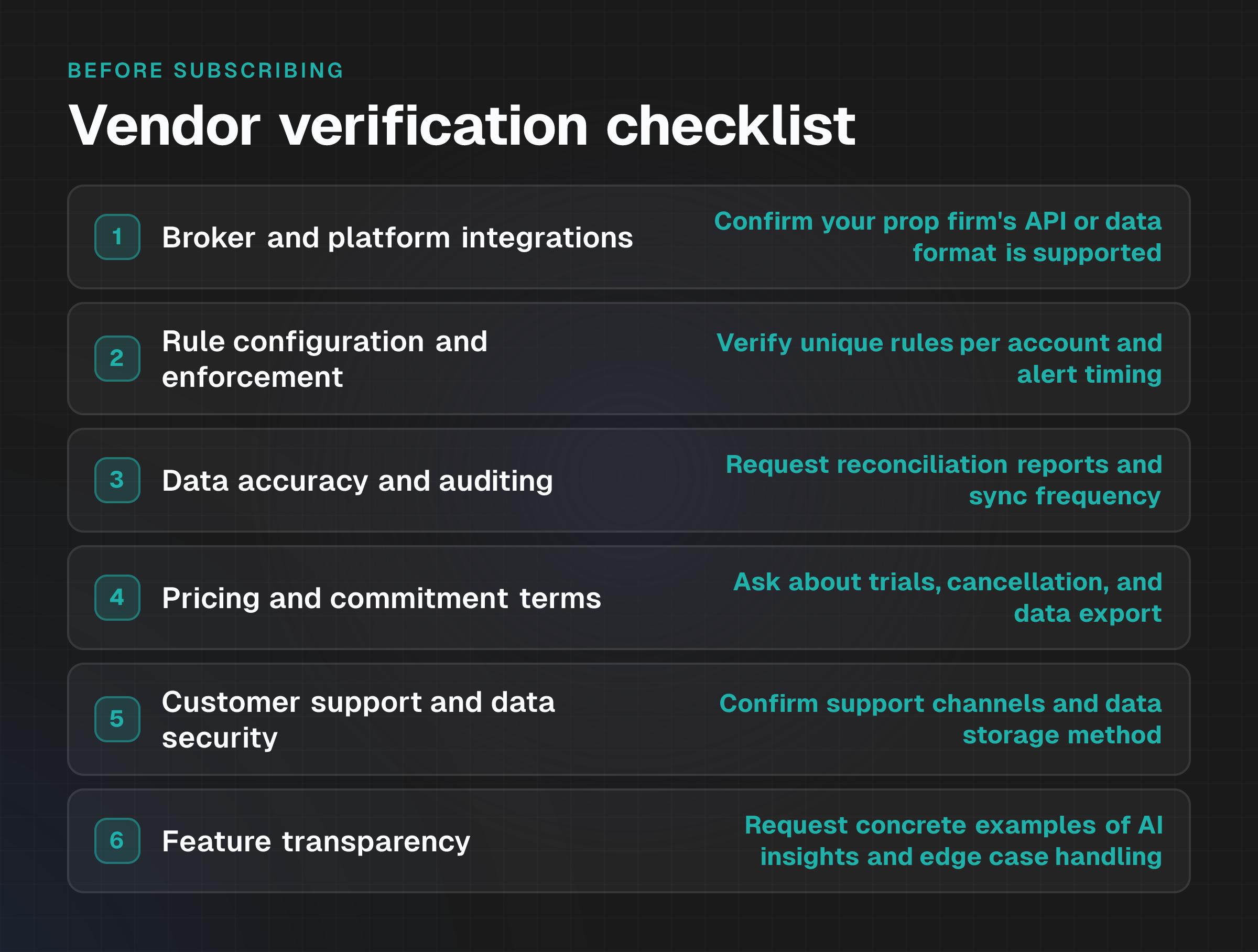
Before committing to any platform, confirm these specifics directly with the vendor:
1. Broker and platform integrations
- List every prop firm platform your target journal claims to support: MetaTrader 5, Tradovate, NinjaTrader, TradeLocker, Rithmic, cTrader, others.
- Ask whether your specific prop firm's API or data export format is officially supported.
- Determine whether unsupported integrations fall back to CSV import, and how flexible the column mapping is.
2. Rule configuration and enforcement
- Confirm the journal tracks daily loss limits, maximum drawdown, and profit targets.
- Verify whether you can configure unique rules for each account, different DLL thresholds, drawdown limits, or profit targets per firm.
- Check whether alerts or warnings appear when you approach a limit, and whether the journal prevents trades that would breach it or only flags them after execution.
3. Data accuracy and auditing
- Ask how trades are validated after import: are there reconciliation reports that compare your journal to your broker statement?
- Request details on how commissions, fees, and slippage are calculated, especially if your prop firm charges specific rates.
- Determine the frequency of data sync: real-time, end-of-day, manual.
4. Pricing and commitment terms
- Request current pricing and whether costs vary by the number of accounts or trade volume.
- Ask about free trials, money-back guarantees, or trial periods.
- Clarify the terms for cancellation and data export if you decide to leave.
5. Customer support and data security
- Verify what support channels are available, email, chat, phone, and typical response times.
- Confirm how your trading data is stored: local, cloud, hybrid. Ask whether encryption is used.
- Ask whether data can be exported in a portable format (CSV, JSON, or similar) if you switch platforms.
6. Feature transparency
- If the vendor mentions AI-powered pattern detection or behavioral insights, ask for a concrete example of what the AI identifies and how it differs from basic statistical analysis.
- Request documentation or a demo showing how the tool handles edge cases: gaps in trade data, trades that span multiple days, cancelled orders, partial fills.
FAQs
What's the difference between a daily loss limit and maximum drawdown?
A daily loss limit (DLL) is a hard ceiling on losses within a single calendar day. Lose $1,000 on Monday, you may be blocked from trading until Tuesday.
A maximum drawdown is the largest cumulative loss from your starting balance (or a recent peak) measured over a longer period, often the entire evaluation or funded account phase.
Exceed either, you typically face account suspension or forfeiture. Both must be tracked separately and monitored in real time.
Can I use a spreadsheet instead of a dedicated journal?
Spreadsheets offer flexibility and cost nothing, but they require manual entry of every trade and rule calculation, DLL remaining, drawdown percentage, profit target progress.
The practical limitation: spreadsheets make it easy to skip entries during busy trading sessions, which undermines the data accuracy prop firms expect. A repeated association is evidence worth reviewing, not proof of causation. AI Trading Journal vs Spreadsheet: Which Is Better? compares the trade-offs in detail.
How do I know if a journal's AI pattern detection is reliable?
AI in trading journals typically performs statistical analysis, finding trades that share similar entry prices, times, or outcomes, or behavioral classification, labeling trades as impulsive, revenge-driven, or planned based on timing and sequence.
Ask the vendor for a concrete example of a pattern their AI identifies and how it verifies accuracy. The tool can show that a pattern appeared in recorded trades; it can't establish with certainty why it occurred. Behavioral observations should be checked against the underlying recorded trades before taking action.
What happens to my data if I leave the platform?
Before subscribing, confirm whether the journal exports your trade history, performance statistics, and account configurations in a portable format, CSV, JSON, or similar.
Without export capability, switching platforms or a platform becoming unavailable could mean losing months of trading records. This is especially critical if your prop firm or auditor ever requests historical evidence of your trading.
Do I need a journal if my prop firm already provides performance dashboards?
Prop firm dashboards track your P&L and compliance status but typically don't capture trade rationale, emotional notes, or behavioral patterns.
A journal serves a different purpose: it supports learning and self-review. A losing trade can follow a sound process, while a winning trade can result from a poor decision. Your firm's dashboard shows compliance. Your journal helps you understand why.
How often should I review my journal?
Depends on your trading frequency and prop firm phase.
During evaluation phases, weekly reviews are common to catch behavioral patterns early. Funded account traders often review daily to stay aware of drawdown proximity and ensure consistent discipline. The useful question isn't which tool sounds more advanced, but which workflow you can maintain consistently. Stop Bad Trading Habits: Review Decisions With Real Data outlines a practical review structure.