
Day Trading Journal: What to Record, With a Filled-In Example
- HybridTrader Editorial

A day trading journal captures objective trade data, entry and exit prices, position size, profit or loss, alongside subjective observations about decision-making and emotional state. The distinction matters. Bare facts recorded during or immediately after a trade minimise bias from memory or outcome, while reflection deepens during dedicated daily or weekly review sessions. The useful question is not which tool sounds more advanced, but which workflow the trader can maintain consistently.
This guide shows what structured journal entries should contain, when to record facts versus reflection, and how to review repeated patterns without confusing association with causation.
Quick answer: What a working journal captures and when
A working day trading journal records two kinds of information on separate timelines. Bare facts, date, entry and exit times, instrument, direction, position size, entry price, exit price, stop-loss level, take-profit level, profit or loss, and the trade setup that triggered the entry, should be recorded as close to real-time as possible, which minimises bias from memory or the trade outcome.
Market context at the time of trade (key economic news events, overall market sentiment, relevant technical indicators) can be added to support later review, though this context cannot make an individual trade predictable. Initial reflection, immediate thoughts, emotional state, deviations from the plan, captures raw responses before significant cognitive bias sets in, also recorded close to the event.
Deeper reflection belongs in dedicated daily or weekly review sessions. That's when broader patterns across multiple trades become visible and behavioural observations can be checked against the underlying recorded trades.
What the behaviour may look like: Structure and consistency in data entry
Consistent journal structure supports meaningful review. Trades should be entered into uniform fields or columns: date, instrument, entry, exit, profit/loss, setup, and notes. Tags or labels help filter data later, by strategy type, market condition, emotional state, or trade outcome.
Without consistency, comparing one trade to another becomes difficult. Patterns that might otherwise emerge remain invisible.
Incomplete or disorganised entries create blind spots. If only winning trades are recorded in detail while losses are rushed or skipped, the journal can't show what actually happened across all outcomes. Vague entry conditions and exit reasons mean later review can't distinguish a well-executed plan from a reactive decision. If emotional state is never recorded, the journal captures mechanics but misses the human layer where repeated behavioural patterns often live.
Review prompts, structured questions added to each entry or session, encourage consistent reflection. Useful prompts include: "What was the rationale for this entry?", "What went well?", "What could have been done differently?", and "Was the plan followed?"
What evidence a journal can record: Objective trade data and initial observations
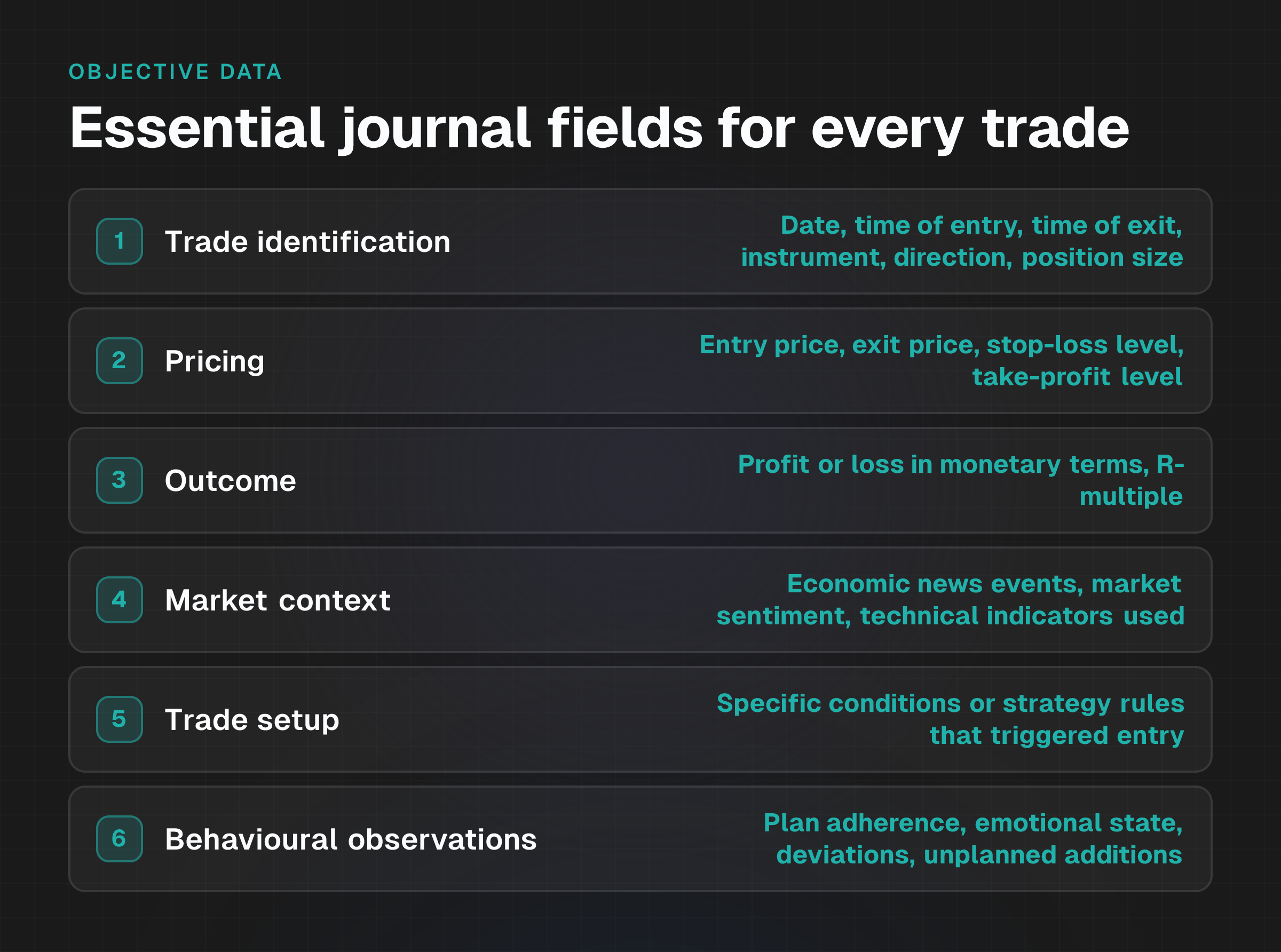
A journal can record and aggregate these objective facts across multiple trades:
- Trade identification: Date, time of entry, time of exit, instrument, direction (long or short), position size
- Pricing: Entry price, exit price, stop-loss level, take-profit level
- Outcome: Profit or loss in monetary terms, R-multiple (risk-to-reward ratio used in the decision)
- Market context: Which economic news events were live, overall market sentiment (macro context, capital flows), technical indicators used to support the entry signal
- Trade setup: The specific conditions or strategy rules that triggered the entry decision
The journal can also record initial, factual observations about behaviour:
- Whether the trader entered within the planned size or deviated
- Whether the exit followed the plan (take-profit, stop-loss, or discretionary exit)
- Whether the trade was part of a planned sequence or an unplanned addition
- The emotional state reported immediately after the trade (calm, frustrated, uncertain, confident)
- Any deviation from the pre-trade plan stated in writing before entry
These observations are honest self-reporting. Not diagnostic claims. The journal records what happened and what the trader noticed; it doesn't explain causation.
What the data cannot explain: Limits of association and causation
The journal can show that a pattern appeared in recorded trades; it cannot establish with certainty why it occurred. A trader might notice that three losing trades happened on days when market volatility spiked, or that five winning trades followed entries near support levels. These are associations worth investigating, not proofs of causation.
Market context can support review, but it cannot make an individual trade predictable. Recording that a trade was placed during a central bank announcement or a trending market is useful data for review; it doesn't guarantee similar trades in similar conditions will produce similar results.
A losing trade can follow a sound process, while a winning trade can result from a poor decision. Evaluating decision quality separately from profit or loss prevents the journal from being rewritten by outcome. A trade that broke the plan but made money provides no evidence that breaking the plan was correct. Conversely, a trade that followed the plan but lost money doesn't mean the plan failed.
One winning or losing trade is insufficient evidence of a repeated pattern. A single entry, even if it lines up with a behavioural observation (e.g., "I was frustrated") or a market condition (e.g., "volatility was high"), is an anecdote. Not a pattern. Patterns require multiple, consistent occurrences recorded across different sessions and instruments.
Missing or inconsistent records may distort analysis. If a trader journals only after profitable sessions or abandons the habit after a drawdown week, the data set becomes skewed. The journal then reflects recording behaviour, not trading behaviour.
How to review repeated occurrences: Filtering, comparing, and checking observations against facts
Reviewing repeated patterns requires separating the data into subsets and examining consistency. Practical steps:
-
Filter by a single variable: Group trades by strategy type, market condition, time of day, or instrument. Look for patterns within that subset. For example: "Which strategies have the longest average hold time?" or "Do losses cluster on days with high volatility?"
-
Compare decision quality across outcomes: Take five winning trades and five losing trades, then record the setup conditions, plan adherence, and emotional state for each. Look for differences in process, not just price movement. A trader might find that winning trades often included a pre-entry pause to confirm the signal, while losing trades were entered without that pause, a process difference, not a market difference.
-
Check behavioural observations against recorded facts: If a trader reports frustration after a losing trade, confirm whether the trade deviated from the plan (a fact that supports that emotion) or followed the plan (a fact that might suggest the emotion was about the outcome, not the decision). This is checking observation against evidence, not assuming emotion caused the outcome.
-
Count occurrences across multiple sessions: A behaviour worth reviewing should appear in at least three to five trades across different days. One or two instances are insufficient to establish a pattern.
-
Look for internal consistency: If a trader claims to have followed the plan on a winning trade but the recorded entry price was outside the planned range, the facts contradict the observation. The journal highlights these gaps so the trader can investigate further.
For guidance on identifying patterns in journal data, see the linked analysis.
Questions to ask after the trade: Structured reflection without outcome bias
Immediate post-trade reflection should focus on process. Not result. Useful questions include:
- What was the specific rationale for entering at that price?
- Were all the conditions in the plan confirmed, or were any skipped?
- What emotional state was present before entering? During the trade?
- Was the exit plan followed, or was it overridden? If overridden, why?
- Was the position size correct according to the risk calculation?
- Did any unexpected event (news, volatility spike, order execution delay) change how the trade was managed?
Later, during daily or weekly review, ask:
- Looking only at the setup conditions and entry, was this a good decision at the time?
- How does the decision quality compare to similar trades in the journal?
- Did the trade outcome match, beat, or miss the stated risk-reward ratio?
- Is there any pattern between the trades reviewed this week and the trades from last week?
- Where was the plan deviated from, and was that deviation intentional or reactive?
These questions separate decision quality from outcome. A poorly executed trade that made money shouldn't be celebrated as a good decision. A well-researched entry that lost money shouldn't be marked as a failure of judgment. For help distinguishing good process from outcome bias, read Stop Bad Trading Habits: Review Decisions With Real Data.
Practical review checklist: Daily and weekly review workflow
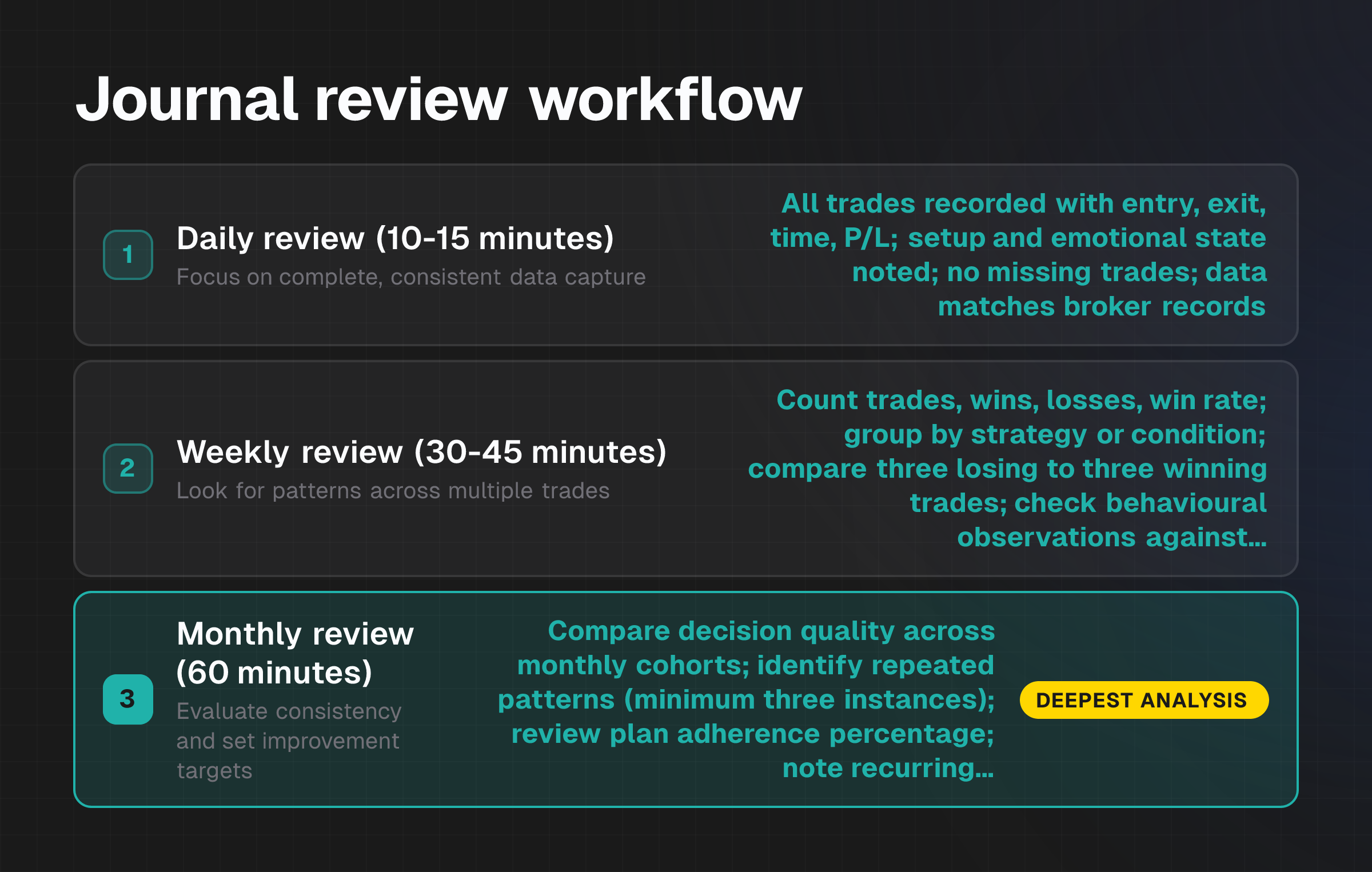
Daily review (10-15 minutes)
- All trades from the session are recorded with entry price, exit price, time, and profit/loss
- The trade setup or strategy label is filled in for each trade
- Initial observations about plan adherence and emotional state are noted
- No trades are missing or left vague
- The data is consistent with broker statements or trade execution records
Weekly review (30-45 minutes)
- Count total trades, wins, losses, and the win rate for the week
- Group trades by strategy, market condition, or time of day; note any cluster of outcomes
- Select three losing trades; record the setup, plan adherence, and emotional state; compare to three winning trades in the same strategy or condition
- Check whether behavioural observations (e.g., "frustrated") align with process deviations (e.g., "entered without confirming the signal")
- Identify one process question to investigate in the coming week (e.g., "Do exits tend to happen too early near support levels?" or "Does size increase after a loss?")
- Don't allow outcome alone to validate or invalidate a decision; evaluate the process separately
Monthly review (60 minutes)
- Compare decision quality across monthly cohorts; note whether consistency is improving
- Identify repeated patterns (at least three instances across different weeks) that merit focused attention
- Review plan adherence: what percentage of trades followed the pre-written plan?
- Note any recurring emotional state or market condition associated with repeated losses or wins
- Set one specific behaviour or process to improve next month, based on the data
Limitations: What journaling cannot do and what it requires
A trading journal is only effective if its contents are regularly analysed and acted upon. A trader who records entries but never reviews them gains no insight. The journal is a tool for investigation, not a substitute for a trading strategy, risk controls, or personal responsibility.
Journaling doesn't guarantee improved profitability, higher win rate, or reduced emotional trading. It provides evidence for self-review; how that evidence is interpreted and acted on depends entirely on the trader.
Consistency in recording is essential. Irregular or selective journaling distorts the data set. A trader who records only after profitable sessions or stops journaling during drawdowns can't see the full picture of behaviour.
Confirmation bias, seeking only information that supports existing beliefs rather than objectively analysing all trade data, is a common pitfall. A journal containing only rationalisations for losses or only celebrations of wins doesn't support improvement. Honest, unflinching review of both winning and losing trades, regardless of outcome, is required.
Over-journaling, recording excessive unstructured data, can lead to analysis paralysis and make regular review impractical. Under-journaling prevents meaningful insights. The balance depends on what a trader can sustain: the most advanced journal is worthless if it's abandoned after a week.
Next step: Start with bare facts and one weekly review cycle
Begin by recording only bare facts for one week: trade date, entry price, exit price, position size, profit or loss, and the strategy or setup label. Add initial observations (emotional state, plan adherence) in a brief note field immediately after the trade. Don't attempt deeper reflection during the session.
After one week, set aside 30 minutes for a single weekly review. Group the trades by strategy or market condition, then select one question to investigate, for example, "Which entries had the highest accuracy?" or "Did any trades break the plan?", and answer it using only the data recorded. This single cycle tests whether the structure works and whether review is actually feasible.
Once one weekly cycle is routine, add a daily 10-minute review to catch incomplete entries and fix inconsistencies before they accumulate. Extend reflection questions gradually as the journal habit becomes stable.
For more on structuring entries for review, see the Forex Trading Journal: Day-to-Day Setup guide. To understand how market context shapes decision review, read How to Journal Trades Around High-Impact Economic Events. Traders looking to spot specific behavioural patterns can review Revenge Trading: How to Spot Patterns in a Journal.
FAQs
What data should be recorded during a trade versus after it closes?
Record objective facts, entry price, time, instrument, position size, as close to real-time as possible to minimise memory bias. Exit price, exit time, and profit or loss can be recorded immediately after the trade closes. Emotional state and initial observations should also be noted immediately, before the outcome biases recollection. Deeper reflection and pattern analysis belong in a separate, dedicated review session.
How can bias be avoided when reviewing trades?
Separate decision quality from outcome. Ask "Was this a good decision based on the information available at the time?" rather than "Did this trade make or lose money?" Review both winning and losing trades with equal rigour. Check any behavioural observation (e.g., "emotional") against the recorded facts (e.g., "Was there a deviation from the plan?"). Look for patterns only after at least three consistent instances across different sessions.
What if a trade wasn't recorded or an entry detail was forgotten?
Incomplete data distorts review. If a trade wasn't recorded, mark it as missing rather than filling it in from memory later. If key details are vague (e.g., "exited around 1.2000" instead of an exact price), note what's uncertain. Don't discard the trade, but flag it in review as incomplete. This teaches consistency; over time, the cost of missed or vague entries becomes obvious, and discipline improves.
Can a journal predict which trades will be profitable?
No. Market context, strategy setup, and past performance can all be recorded, but they can't make an individual trade predictable. A well-designed journal shows patterns in recorded behaviour and outcomes, not future price movement. Use the journal to review decision quality and process consistency, not to forecast profits.
How often should the journal be reviewed?
A minimum weekly review (30-45 minutes) is practical for most traders. Daily reviews (10-15 minutes) catch incomplete entries and fix inconsistencies before they accumulate. Monthly reviews (60 minutes) allow tracking progress on specific behavioural or process questions. The schedule depends on trading frequency; a trader executing 20 trades per week needs more frequent reviews than one executing 5 trades per week.
Is a spreadsheet adequate, or is specialised journaling software needed?
The comparison depends on recording habits, required integrations, data controls, and preferred workflow. A spreadsheet requires manual discipline but offers full control and flexibility. Specialised software automates data entry and filtering, but only if it integrates with the broker. The useful question is not which tool sounds more advanced, but which workflow can be maintained consistently. Many traders benefit from structured prompts and automated pattern detection; others prefer simplicity. Test both before committing. For a detailed comparison, read AI Trading Journal vs Spreadsheet: Which Is Better?
This piece draws on the brand's published materials and verified public sources. Last verified 7 November 2026.