
How HybridTrader Reviews Decision Quality
- HybridTrader Editorial
A profitable trade can follow poor reasoning. A losing trade can execute a sound process. Most traders judge decisions by their outcomes alone, creating a blind spot: they cannot distinguish between a good decision that happened to lose money and a bad decision that got lucky. An AI-assisted trading journal addresses this by separating decision quality from trade results, using automated data capture, structured reflection, and pattern analysis to flag where emotions or plan deviations may have influenced execution, independent of whether the trade was profitable.
HybridTrader's system syncs closed trades from over 50 connected platforms, captures pre- and post-trade notes, integrates market context, and uses two AI tools, the AI Psychologist and AI Coach, to identify recurring behavioral patterns and flag trades where execution diverged from the trader's documented plan. This workflow helps traders examine their decision-making process directly, rather than inferring it backward from the P&L.
Quick answer: How decision review works in an AI-assisted journal
The system automates trade import. It captures structured pre- and post-trade notes. Then it analyzes patterns that suggest emotional trading or plan deviations.
HybridTrader syncs closed trades from connected platforms, integrates market context, and flags trades where execution diverged from the trader's documented plan. The AI Psychologist reads closed trades for discipline, cost, and repeat patterns; the AI Coach reviews trades against individual history. A profitable trade can follow terrible reasoning, while a losing trade can execute a flawless process. This workflow helps traders identify whether poor results stem from unsound decision-making or from external market conditions, though the distinction isn't always clear-cut.
The problem it addresses
Traders judge decisions by their outcomes.
It's reflexive. A profitable trade appears to validate the decision, even if it followed poor reasoning or broke the trading plan entirely. A losing trade seems to prove the decision was flawed, even if it followed sound logic and risk discipline at the time.
This outcome bias makes it difficult to identify what actually caused a result. Was the loss a sign the strategy is broken, or that execution deviated from the plan? Was the win due to a solid setup, or did luck overcome a poor decision? Without separating decision quality from trade results, traders cannot reliably improve their process, they can only chase outcomes.
How to Find Trading Patterns in Your Journal explores this challenge in more depth.
What the feature does
HybridTrader's decision review system analyzes closed trades to identify patterns related to discipline, execution costs, and behavioral tendencies. It works through two complementary tools.
The AI Psychologist reads closed trades to flag patterns related to discipline, sticking to position size or entry/exit rules, cost factors such as slippage and commissions, and recurring emotional or psychological influences on decision-making. The AI Coach reviews trades against the trader's individual history, documented strategies, and predefined rules. It flags deviations from the plan and highlights consistent successes or failures tied to specific decision-making patterns.
Together, these tools help traders move beyond asking "Did I make money?" to asking "Was my decision sound, and where did my execution diverge from my plan?"
What data it uses
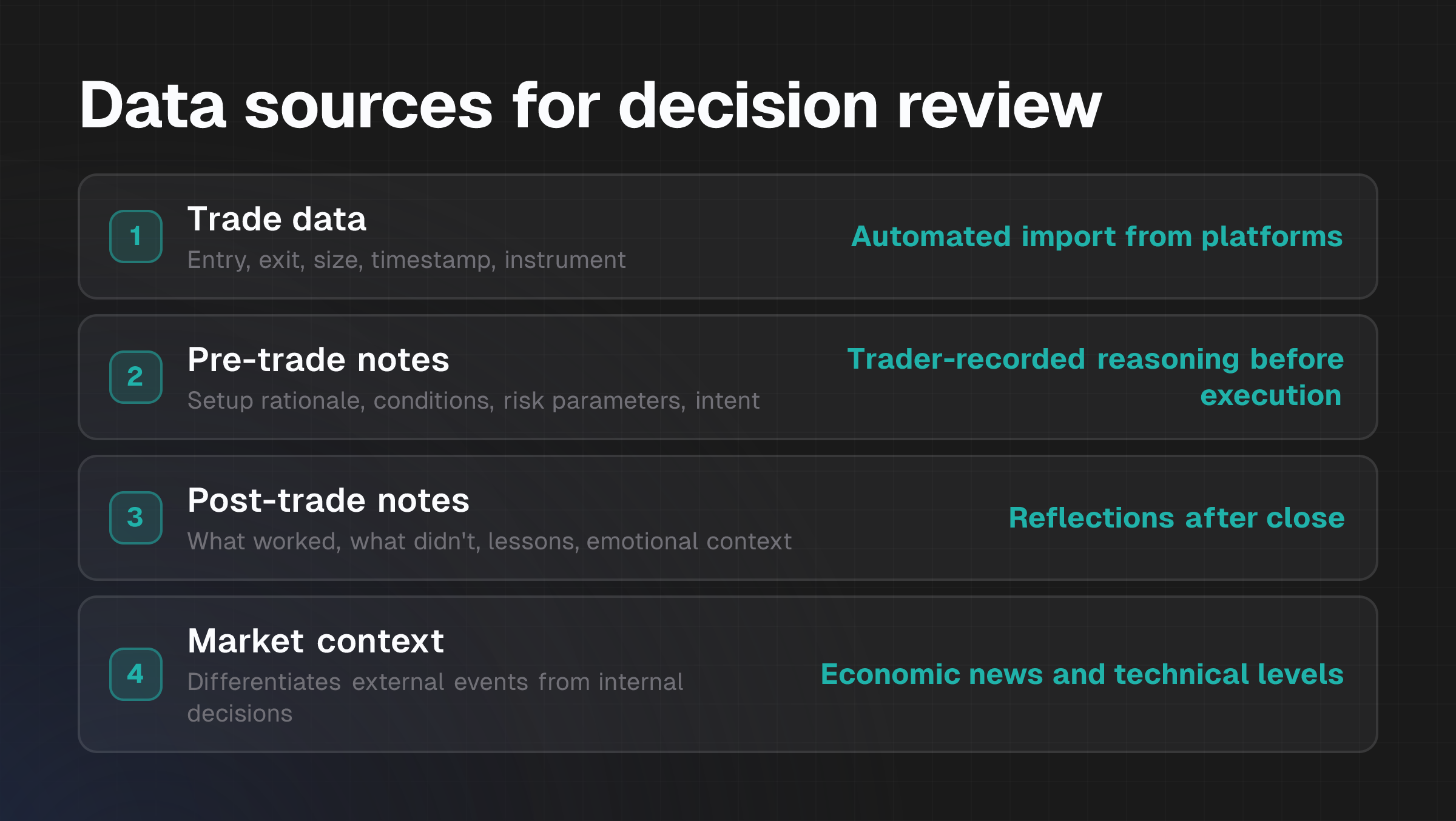
The system draws on several data sources to construct a complete picture of each trade.
Trade data automatically imports from 50+ connected trading platforms, including entry price, exit price, position size, timestamp, and instrument. Pre-trade notes capture trader-recorded reasoning before execution: setup rationale, intended entry and exit conditions, risk parameters, and strategy intent. Post-trade notes document trader reflections after the trade closes, what went well, what didn't, lessons learned, and emotional context. Market context layers in economic news, technical levels, and broader market conditions at the time of the trade, helping differentiate between outcomes driven by external events and those stemming from internal decision flaws.
The accuracy and depth of insights are directly proportional to the quality and completeness of imported trade data and user-entered notes. Incomplete or biased notes can lead to skewed analysis.
How the workflow works
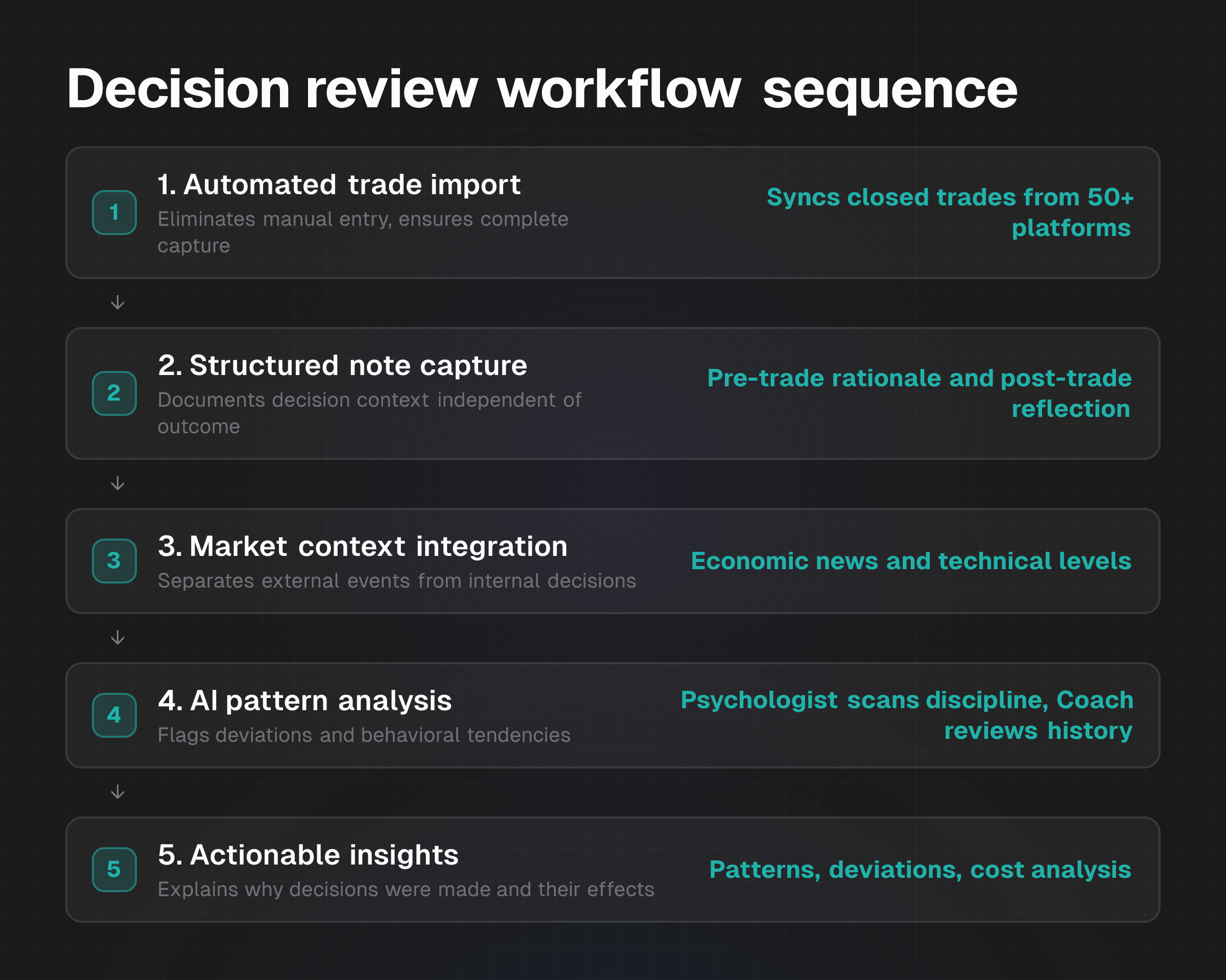
The decision review process follows a structured sequence.
Automated trade import syncs closed trades from connected platforms into the journal, eliminating manual data entry and ensuring comprehensive trade capture. Traders then record pre-trade rationale, setup, entry/exit conditions, risk management, and post-trade reflections. This documentation provides the context needed to assess decision quality independently of the outcome. The journal integrates relevant market data and news events surrounding each trade, helping isolate whether external shifts in market conditions or internal decision flaws drove the result.
The AI Psychologist scans for patterns in discipline, cost, and behavior; the AI Coach compares each trade against the trader's documented strategies and historical performance. The system highlights instances where trade execution diverged from the documented plan, surfacing areas for behavioral correction or strategy refinement. AI algorithms analyze aggregated trade data and notes to uncover recurring emotional influences, execution errors, or consistent strengths in decision-making, independent of profitability. The system surfaces actionable insights that explain not just what the outcome was, but why the decision was made and how it led to that result.
Trading Plan Adherence: How to Measure It in Your Journal dives deeper into measuring execution consistency.
What the output means
The system produces insights that highlight patterns, deviations, and behavioral associations within recorded trading history.
Pattern identification shows recurring associations between certain behaviors, emotional trading, oversizing, deviation from plan, and trade outcomes. These associations are evidence worth reviewing, not proof of causation. Deviation reports flag trades where execution diverged from the documented plan, helping identify where discipline or strategy adherence broke down. Behavioral insights surface observations about decision-making tendencies: a pattern of tightening stops when losing, or adding to winners during volatile conditions. Cost analysis breaks down execution costs like slippage and commissions, and how they correlate with specific trading conditions or decision patterns.
These outputs support self-awareness and structured review. They do not prescribe specific trading actions or guarantee improved results.
What it cannot prove
Several important limitations constrain what this system can establish.
The journal can show that a pattern appeared in recorded trades; it cannot establish with certainty why it occurred. A repeated association between a behavior and an outcome is evidence worth examining, not proof that one caused the other. AI can only analyze what is recorded, nuances of emotional state during the trade, external unrecorded events affecting decisions, or shifts in confidence between trades may be missed entirely. The system cannot tell you what would have happened if you had made a different decision. Market context can support review, but it cannot make an individual trade predictable in retrospect.
Neither AI-assisted journaling nor any analytical tool guarantees improved profitability, a higher win rate, or reduced losses. The useful question is not which tool sounds more advanced, but which workflow the trader can maintain consistently.
What an AI Trading Journal Records (and What It Cannot Know) explores these boundaries in detail.
Privacy, security and user control
Trading data and personal notes are sensitive information.
The research confirms that privacy concerns exist around sharing detailed trading data and personal reflections with an AI system, though specific details of HybridTrader's data handling, encryption, retention policies, and user controls are not covered in this article. Traders evaluating any AI-assisted journal should review the platform's privacy policy and data security practices directly before connecting trading accounts or uploading notes. The choice to share behavioral data with an AI system is a personal decision based on your own risk tolerance and trust in the platform's safeguards.
Who it may suit
Decision review tools are most useful for traders who want to separate decision quality from trade outcomes, and recognize that a profitable trade does not necessarily mean the decision was sound.
They suit traders who maintain detailed pre- and post-trade notes and are willing to invest time in consistent journaling. They work for traders interested in identifying recurring behavioral patterns, emotional trading, plan deviations, execution gaps, and willing to act on that feedback. Structured, data-driven reflection appeals more to some traders than intuitive or informal review. Traders working across multiple instruments or platforms need a centralized way to capture and analyze their decisions.
The workflow depends on recording habits, required integrations, data controls, and preferred review style. Traders who do not maintain detailed notes, or who prefer informal reflection, may find less immediate value in an AI-assisted system.
The full picture is in Stop Bad Trading Habits: Review Decisions With Real Data, which offers guidance on building a review habit.
Next step
If decision review resonates with your trading process, the next step is to clarify what you want to learn about your own decision-making.
Are you interested in spotting recurring emotional patterns? Measuring adherence to your trading plan? Understanding where execution costs are highest? Identifying which strategies have worked best in your own history? A clear learning goal makes it easier to evaluate whether an AI-assisted journal fits your workflow and to use the feedback it produces.
Start by reviewing a few of your recent trades manually, documenting your reasoning, and noting patterns you notice, then consider whether an automated system would help you scale that review process. How to Journal Trades Around High-Impact Economic Events offers a concrete example of structured trade review in practice.
Ready to examine your decision-making separate from outcomes, sign-up with HybridTrader today and improve how you trade.