
Trading Plan Adherence: How to Measure It in Your Journal
- HybridTrader Editorial

Plan adherence means executing trades according to the predetermined rules documented in a trading plan, and recording whether that execution matched the plan's criteria, regardless of whether the trade was profitable. It's a measure of process consistency, not a predictor of profit or loss. A trade can be fully adherent to plan yet result in a loss; conversely, a winning trade can violate the plan's rules. The distinction is critical: adherence tracks whether a trader followed their own defined process, while outcome tracks profit or loss. Both matter for different reasons, but they're separate dimensions of trading behavior.
This article is for active traders who want to improve decision consistency by tracking plan adherence in their journal, then using that data to identify behavioral patterns and refine their process, without confusing process quality with immediate returns.
Quick answer: Why separating adherence from outcome matters
Plan adherence is the degree to which an executed trade matches the predetermined criteria of a trading plan as documented before execution.
It's not an indicator of trade outcome. A trader might follow every rule and still lose money on a single trade or even a series of trades if the plan itself is poorly designed. Conversely, breaking multiple plan rules can lead to a profitable trade through luck or opportunity. Tracking adherence allows evaluation of process quality independently from short-term results. This separation is essential because it enables objective review of decision-making habits, regardless of whether those decisions happened to be profitable.
What the behaviour may look like
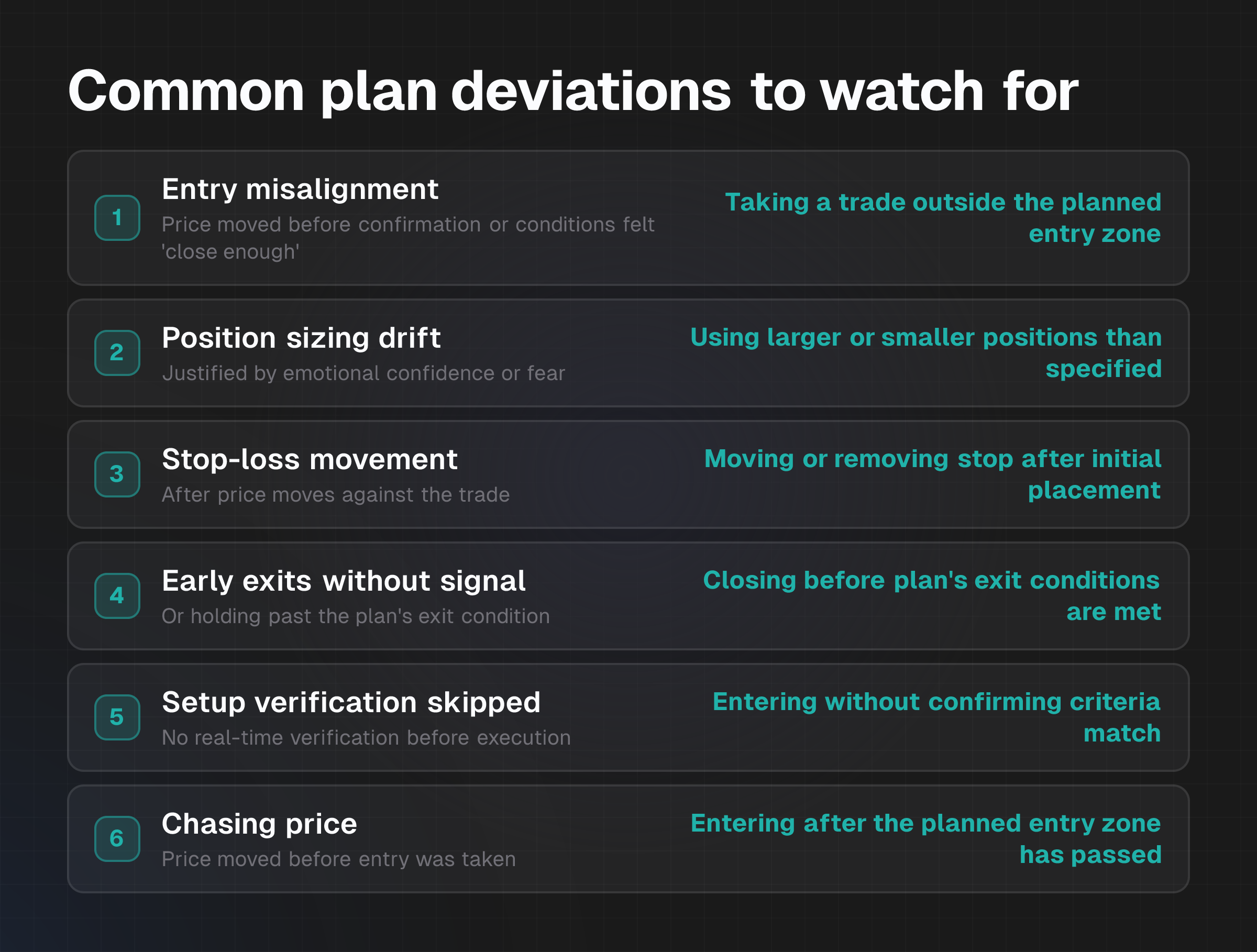
Non-adherence typically manifests as repeated deviations from plan rules.
Entry misalignment: Taking a trade outside the planned entry zone because market conditions feel "close enough" or price moved before confirmation arrived.
Position sizing drift: Using larger or smaller positions than the plan specifies, often justified by emotional confidence or fear.
Stop-loss movement: Placing the initial stop-loss correctly, then moving it wider (or removing it entirely) after price moves against the trade.
Early exits without signal: Closing a trade at a small profit or loss before the plan's exit conditions are met. The opposite also occurs: holding past the plan's exit condition hoping for additional profit.
Setup verification skipped: Entering a trade without confirming that market conditions actually matched the plan's setup criteria. Related is chasing price: entering after the planned entry zone has passed because price moved before entry was taken.
These are observable behaviors, not judgments. A trader who frequently enters outside the planned zone while still being profitable has a consistent pattern worth examining, not a moral failing.
What evidence a journal can record
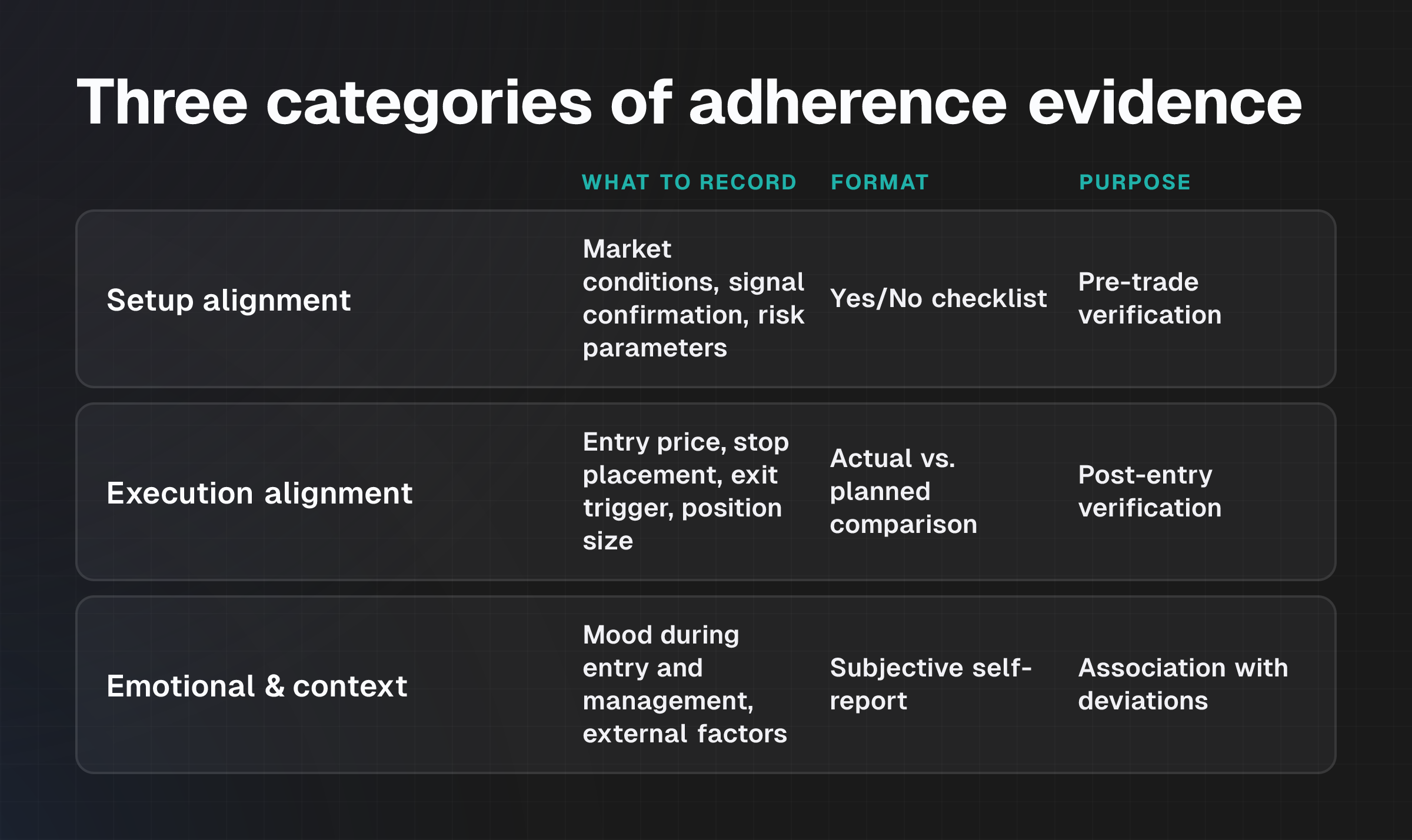
A journal designed to track plan adherence should record specific, yes-or-no or quantitative comparisons between plan and execution.
Setup alignment (pre-trade verification)
Market condition checks: Did the trader confirm trend direction, volatility level, support/resistance placement, and any other market criteria specified in the plan before entering?
Technical signal confirmation: Did the identified signal (e.g., pullback to 20-EMA after trend break) actually occur, or was a similar-looking setup substituted?
Risk parameter verification: Was the maximum acceptable loss per trade calculated and confirmed before entry? Was position size determined by the plan's formula (e.g., based on account size and risk per trade) before entering?
Record these as checklist items: "Plan specified entry on pullback to 20-EMA. Entry occurred at 20-EMA: Yes / No." If no, record what actually triggered entry.
Execution alignment (post-entry verification)
Entry price vs. planned zone: Record the actual entry price and the planned entry zone. Note whether they matched, and by how much if they diverged.
Stop-loss placement: Record the initial stop-loss level and compare it to the plan's stop-loss rule (e.g., "2% below entry" or "below recent swing low").
Take-profit or exit strategy: Record whether the exit was triggered by the plan's exit condition or by a different reason (e.g., "time of day," "felt nervous," "hit profit target earlier than planned").
Position size used: Record the actual position size and compare it to the calculated size.
Any mid-trade deviations: Record if the stop-loss was moved, the position was scaled in or out, or any other adjustment was made, along with the stated reason (e.g., "new support level identified," "felt overconfident," "wanted to lock in gains").
Emotional state and external context
Emotional state during entry: Record mood or felt state (e.g., "confident," "fearful," "rushed," "indifferent").
Emotional state during management: Record any emotional shifts during the trade (e.g., "anxiety increased when price moved 20 pips against entry," "overconfidence grew as trade moved in favor").
External factors: Record any distractions, time pressure, or external events that occurred during the trade.
These emotional records are subjective self-reports, not objective measurements. They're still valuable data because they show how a trader experienced a trade, which can be associated with certain deviations, but emotional state alone doesn't explain behavior. Emotional records should be checked against the actual recorded deviations.
What the data cannot explain
A comprehensive adherence journal reveals what happened and when patterns occur, but it can't definitively explain why.
Emotional records are subjective: Recording "felt fear" is honest self-reporting, but it doesn't prove that fear caused the deviation. The same emotion might lead different traders to different actions, or the same trader to different actions on different days.
Correlation is not causation: If a trader notices that early exits are more common on days when they traded after a loss, that's a documented association, not proof that one caused the other. Other variables, market volatility, time of day, sleep quality, may be involved.
Motivation is reconstructed memory: A trader might record a reason for a deviation post-trade (e.g., "moved the stop because of a new support level"), but this is the trader's interpretation of their own behavior after the fact. The actual trigger may have been different or multiple.
Plan quality is separate from adherence: A high adherence rate to a poorly designed plan proves only that the trader is consistent, not that the process works. Adherence data can highlight which rules are impossible to follow in real-time (e.g., a rule that requires information not available at entry), but it can't validate the plan's effectiveness.
One or two deviations aren't a pattern. Observing a deviation once or twice is useful context; calling it a repeated pattern requires multiple occurrences across different market conditions and timeframes. Missing or incomplete records distort analysis: if a trader journals only the "interesting" trades (winners or large losers), or forgets to record specific deviations, the adherence data will be biased.
How to review repeated occurrences
To move from single observations to patterns, follow a structured review process.
Define the deviation clearly. Example: "Early exit without plan signal" means closing a position before the plan's exit condition was met, not counting normal profit-taking or trailing stops that follow the plan.
Count occurrences across a meaningful period. Review at least 10-20 trades over 1-4 weeks (depending on trading frequency). A single deviation is an event; three or more similar deviations across different sessions is a pattern.
Note the market context for each occurrence. Record the market condition, asset class, time of day, and whether the trade was a winner or loser. Patterns often emerge when market or time conditions are similar.
Check the emotional state records. Are the same emotional states (or absence thereof) recorded before the deviation occurs? If a trader records "overconfident" before eight early exits and "neutral" before two adherent trades, there's an association worth examining.
Examine the plan rule itself. Does the plan rule make sense, or is it consistently impossible to follow? Example: If the plan specifies "exit on a daily close above resistance," but the trader trades intraday and can't consistently observe the daily close, the rule itself may need revision.
Look for external patterns. Did the deviations cluster on certain days of the week, times of day, or after specific events (e.g., news releases, or after winning/losing streaks)?
Calculate adherence rate for that specific rule. Of the last 20 trades where that rule applied, how many followed it? If the rate is below 60%, that rule isn't reliably followed and warrants investigation or redesign.
Questions to ask after the trade
After each trade is closed, use these reflection questions to assess adherence objectively.
On setup alignment
Did the market conditions actually match the plan's criteria, or was there an assumption they were "close enough"?
Was the setup verified in real-time before entry, or was verification done after entry as post-hoc justification?
If the setup didn't match, what made entry happen anyway? (Record this reason, even if it's uncomfortable.)
On execution alignment
Did entry occur at the planned entry zone, or was it a chase after price moved?
Was the stop-loss placed according to the plan rule, or was it adjusted for emotional or technical reasons?
Was the exit triggered by the plan's exit condition, or by an external factor (time, emotion, fear, overconfidence, boredom)?
If position size differed from plan, why? (e.g., "felt too confident and used 1.5x," "felt uncertain and used 0.75x").
On emotional experience
What was the emotional state before entry? During the trade? At exit?
Did the emotional state change during the trade? If so, what triggered the shift?
Did the emotional state correlate with adherence or deviation? (Example: "overconfidence, and stop-loss was moved wider.")
On plan quality
Did the plan rule make sense in real-time, or was it impossible to execute as written?
If the trade deviated, was the deviation necessary due to new information, or was it a discretionary override of the plan?
Record these answers in the journal. Patterns emerge across multiple sessions, not within a single trade.
Practical review checklist
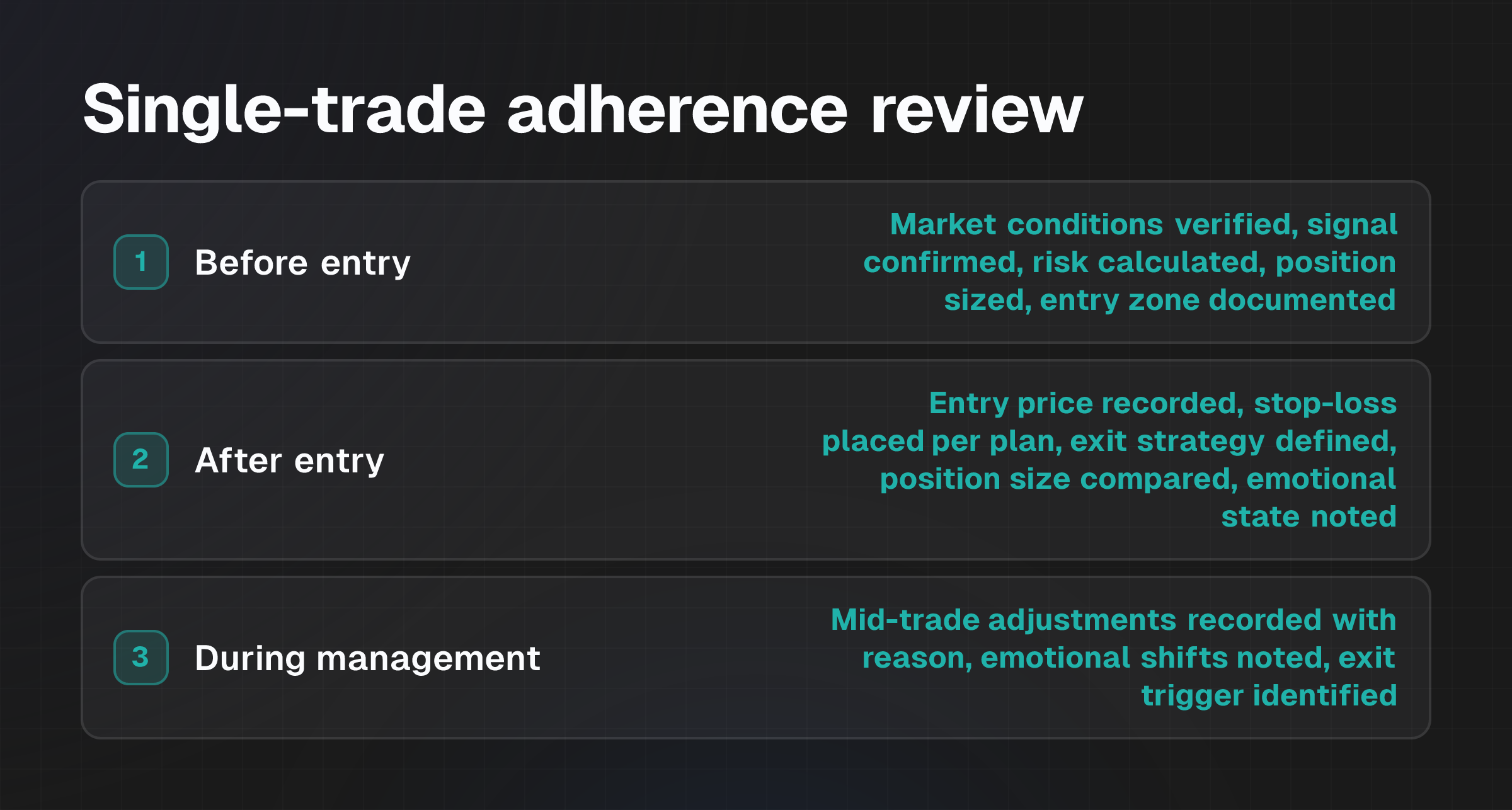
Use this checklist to evaluate plan adherence for a single trade.
Before entry:
- Market conditions verified against plan criteria (trend, volatility, support/resistance levels)
- Specific technical signal or catalyst confirmed to match plan definition
- Maximum acceptable loss per trade calculated
- Position size calculated using plan's formula
- Entry zone identified and documented
After entry:
- Actual entry price recorded and compared to planned entry zone
- Initial stop-loss placed according to plan rule and recorded
- Exit strategy (e.g., profit target, signal-based exit) defined and recorded
- Position size used recorded and compared to calculated size
- Emotional state at entry recorded
During trade management:
- Any mid-trade adjustments (stop-loss moves, scaling, additions) recorded with stated reason
- Emotional state changes noted with approximate time
- Exit trigger identified (plan signal, profit target, fear, time, or other)
After exit:
- Exit price and exit reason recorded
- Profit or loss calculated
- Adherence assessment: Did setup match plan? Did execution match plan? (Yes/No for each)
- Any deviations noted and categorized (e.g., "entry zone missed," "stop-loss moved wider," "early exit")
- Reflection on why deviation occurred recorded
Weekly review:
- Count adherent trades vs. non-adherent trades for each major rule
- Identify any clusters (e.g., "all early exits occurred after losses," "all setup misalignments occurred in volatile conditions")
- Note any rules with adherence below 60%
- Assess whether plan rules are realistic in real-time execution
Limitations
Several factors can reduce the reliability of adherence tracking.
Self-reporting bias: A trader may subconsciously downplay deviations, especially if the non-adherent trade was profitable. ("The rules were broken, but it worked, so it wasn't really a deviation.") Behavioral observations should be checked against the underlying recorded trades and prices, not against memory or rationalization.
Record inconsistency: If a trader journals rigorously for two weeks, then skips entries, then journals again, the pattern analysis will be distorted. Useful adherence data requires consistent record-keeping across multiple sessions.
Complexity leading to fatigue: A system with too many metrics becomes burdensome. The useful question isn't which recording system sounds most advanced, but which workflow the trader can maintain consistently over weeks and months.
Static plan assumption: A trading plan isn't immutable. Reviewing adherence data may reveal that a rule is consistently impossible to follow in real-time or that market conditions have changed. The plan itself may need revision. High adherence to an outdated or unrealistic plan isn't a success.
Confusing consistency with profitability: A trader might achieve 95% adherence and still lose money if the plan itself is flawed. Adherence proves discipline; it doesn't prove the plan is effective. The next step is to evaluate whether the plan's rules (not just adherence to them) are sound.
Ignoring small, repeated deviations: A trader might move stops 5-10 pips wider on half their trades and view it as "minor." Repeated across 50 trades, this small deviation compounds and distorts risk management. Small deviations should be tracked if they recur.
Next step
Adherence review is a diagnostic tool, not a solution in itself.
Once patterns in adherence (or non-adherence) are identified, the next step is to investigate the rules and conditions behind those patterns, rather than to force stricter discipline.
For example: If a trader consistently exits early from winning trades, the question isn't "How do I force staying in longer?" but "Does the plan's profit target make sense, or does it require holding through emotionally difficult drawdowns that can't realistically be endured?"
If setup misalignments cluster in high-volatility markets, the question isn't "The setup rule must be followed exactly," but "Does this setup definition work in volatile conditions, or does it need to be revised for those conditions?"
If stop-loss adjustments occur after rapid adverse moves, the question isn't "Stops should never be moved," but "Is the stop-loss level realistic given the asset's typical intraday moves, or is it being set too close?"
To build this investigation, start by identifying trading patterns, then compare those patterns against the plan's written rules. Where mismatches appear consistently, those are the rules worth re-examining. Journaling around high-impact events can highlight whether adherence changes predictably around specific catalysts.
Adherence tracking doesn't replace a sound trading strategy, risk controls, or personal responsibility for decisions. It's a record-keeping discipline that reveals whether a trader is executing their own plan consistently and where execution diverges from intention. From that evidence, refinement becomes possible.
How HybridTrader records plan adherence
HybridTrader separates trade outcome from the trader’s review of the decision. Imported or manually added trades can be enriched with reflections covering setup quality, execution, plan adherence and emotional state.
The AI coach then reviews those records against the trader’s own history. It can surface repeated relationships in the data, but it cannot determine whether the underlying strategy is profitable from one trade or prove why a trader departed from the plan.
FAQs
What is the difference between plan adherence and good trading decisions?
A trade can adhere perfectly to a plan and still be a poor decision if the plan itself is flawed. Conversely, a trade might break the plan and result in a good outcome by luck or market opportunity. Adherence measures whether the trader followed their own rules; decision quality measures whether those rules are sound. Both dimensions matter, but they're separate. A high adherence rate paired with consistent losses suggests the plan needs revision, not that the trader needs more discipline.
Can profitability happen without perfect adherence?
Yes. A trader might achieve profitability at 70% or 80% adherence if the plan is sound and the non-adherent trades are small deviations or occur in specific contexts that still produce profits. However, wide variations in adherence make it difficult to identify which elements of the plan actually work. Consistent adherence is useful not for guaranteed profit, but for clear, repeatable data that allows plan refinement.
How often should adherence be reviewed?
Review frequency depends on trading volume and the complexity of the plan. A day trader with 10+ trades per week might review weekly. A swing trader with 1-3 trades per week might review monthly. The key is consistency: regular, structured review reveals patterns faster than sporadic review. Where records are incomplete or inconsistent, patterns are harder to identify.
What if plan rules are impossible to follow in real-time?
If a rule consistently proves impossible to execute (adherence below 50% despite genuine effort), the rule likely needs revision, not improved discipline. Document why the rule fails, is the signal not visible in real-time? Does it require information unavailable at entry? Is the timeframe too tight?, then refine the rule to be more realistic or remove it. An achievable plan followed consistently is more useful than an ideal plan broken repeatedly.
Is a winning trade that breaks the plan still a good outcome?
A winning non-adherent trade is a profitable trade, but it doesn't validate the decision. If a trader consistently breaks their plan and wins by accident or by taking on unplanned risk, those wins obscure the underlying decision quality. Over time, uncontrolled deviations tend to increase risk and reduce consistency. Track non-adherent wins separately and ask: did the win happen because the plan works, or despite breaking it?
How can confirmation bias be prevented when recording adherence?
Record facts, not interpretations. Instead of writing "stuck to the plan," write the specific checklist: "Entry zone: planned 1.2500-1.2510, actual 1.2508. Stop-loss: planned 2%, actual 2%. Exit: plan specified signal, actual exit at time of day." Numbers and yes/no answers resist rationalization better than narrative summaries. Review these recorded facts alongside the journal entry to check whether interpretation matches the data.