
How to Record Trades During Fed & FOMC Announcements
- HybridTrader Editorial

Federal Reserve announcements generate significant price movement in minutes. Traders who record decisions before, during, and after these events can separate sound judgment from market volatility and learn from their own patterns. This article explains what to document at each stage, from pre-announcement scenario planning through post-trade review, to build an objective record of decision quality rather than relying on outcome alone.
The Federal Reserve issues formal statements and takes actions regarding monetary policy, primarily changes to the Federal Funds Rate, quantitative easing or tightening, and economic outlook. These announcements are known for rapid and substantial market moves. By structuring what you record before the news, immediately as it breaks, and in the hours after, you create a decision journal tied to a specific, high-impact event that repeats throughout 2026.
Quick answer: What to record around a Federal Reserve announcement
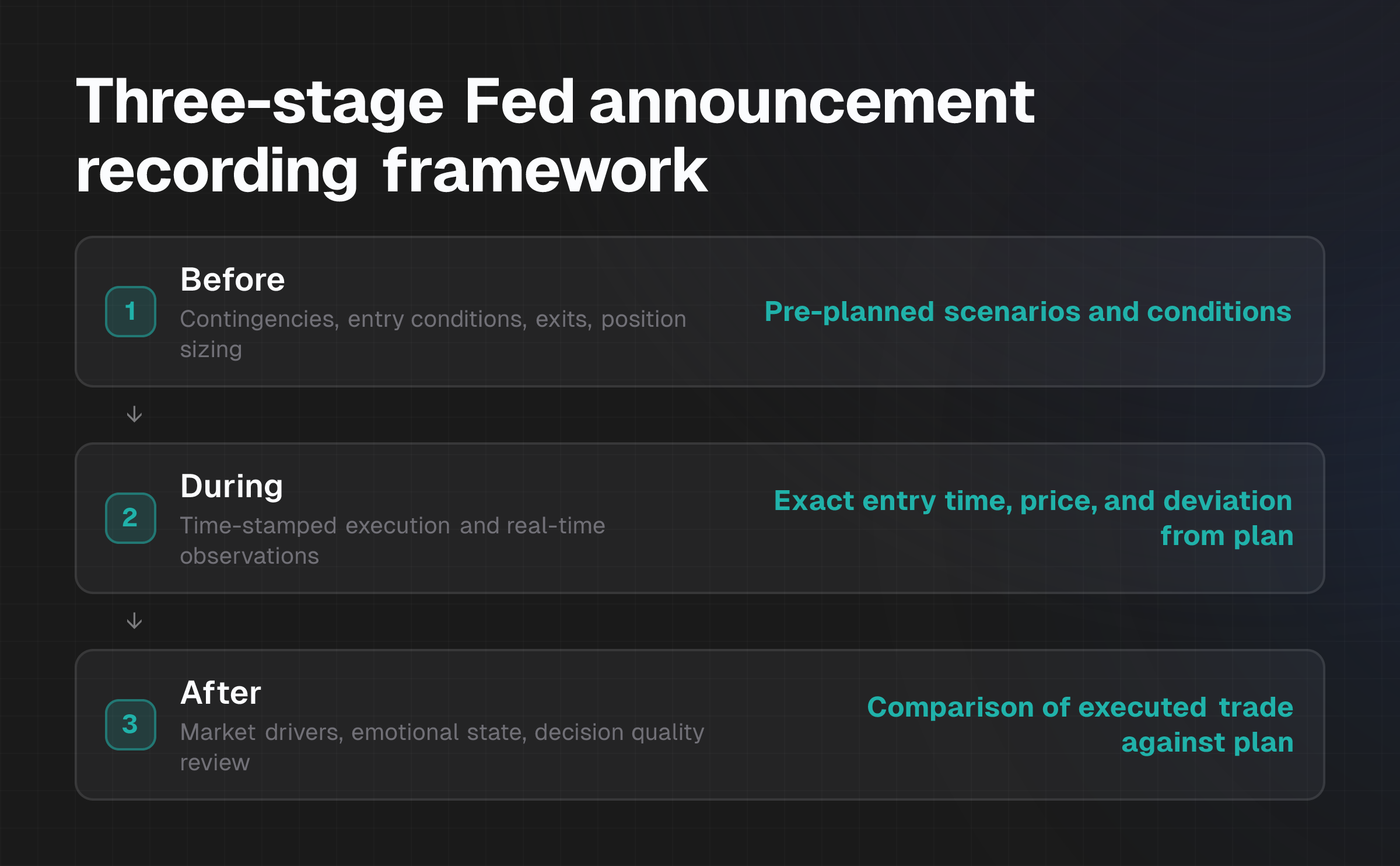
Record three elements. First: your pre-planned scenarios and conditions for trading before the announcement. Second: exact entry time, price, and deviation from plan during the announcement. Third: a comparison of your executed trade against your plan, along with market drivers and your emotional state after the announcement.
This structure lets you review whether you followed a defined process, separate from whether the trade was profitable. A losing trade can follow sound judgment. A winning trade can result from poor decisions.
What the event measures
Federal Reserve announcements communicate changes to the Federal Funds Rate, the target interest rate set by the Federal Open Market Committee (FOMC), as well as shifts in quantitative easing or quantitative tightening, and forward guidance on future policy. The Fed's statement reflects decisions made during an FOMC meeting. A press conference often follows the statement release, during which the Fed chair answers questions that may clarify or add nuance to the headline decision.
Detailed records of FOMC discussions, decisions, and votes, known as FOMC meeting minutes, are released a few weeks after the meeting and provide deeper insight into the Fed's reasoning and internal disagreements.
The exact timing and structure of announcements vary. A typical FOMC rate decision is released at 2:00 p.m. Eastern Time, with a press conference beginning 30 minutes later. The minutes release follows a different schedule, set several weeks in advance.
Why traders monitor it
Federal Reserve announcements influence borrowing costs across the economy. Because the Fed's actions and forward guidance affect interest rates, inflation expectations, and asset valuations, traders across currency pairs, equities, bonds, and other instruments monitor these events closely.
Markets can experience extreme volatility and liquidity challenges in the minutes surrounding the announcement.
Trades often cluster around specific time windows: the moment the statement is released, the opening minutes of the press conference, and the period as market consensus forms around the implications of nuanced policy language. Recording trades during these windows reveals whether you acted on a pre-planned rationale or reacted to price movement alone. This distinction is central to assessing decision quality.
Possible scenarios, not predictions
Rather than forecast a single outcome, develop 2-3 plausible scenarios before the announcement.
Scenarios are possibilities, not predictions, and they shape your preparation without committing you to a direction.
Possible scenarios for an FOMC rate decision might include:
- The Fed raises the Federal Funds Rate and signals further hikes. Market reaction: long-term Treasury yields could rise; the US dollar may strengthen; equities may face pressure.
- The Fed holds the Federal Funds Rate steady and maintains forward guidance. Market reaction: limited initial volatility; price action depends on whether this outcome matches or surprises consensus.
- The Fed holds rates steady but signals future cuts. Market reaction: long-term yields may fall; currencies and equities could shift lower.
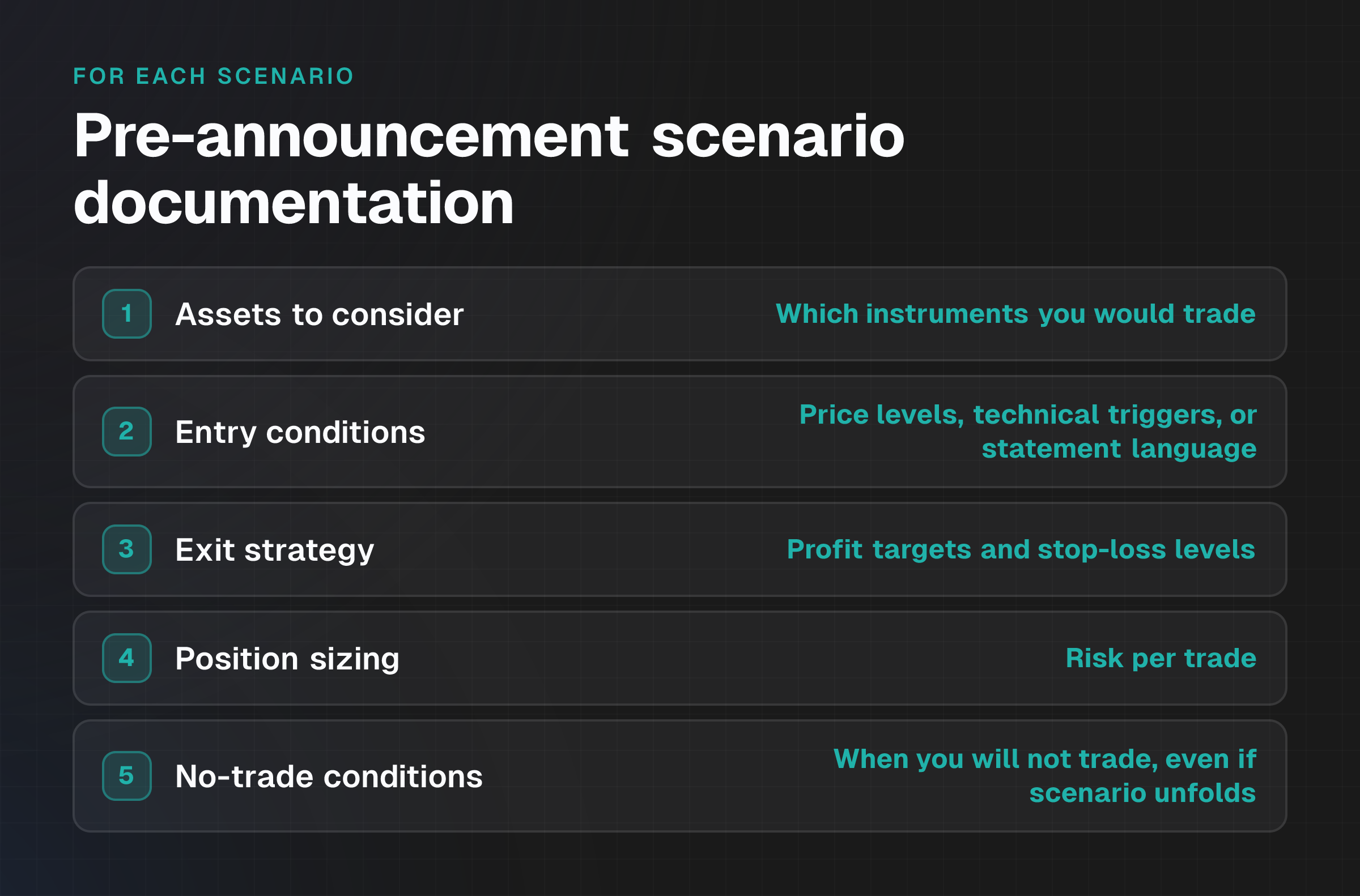
For each scenario, document in advance:
- Which assets you would consider trading (e.g., EUR/USD, Treasury futures, S&P 500 index options).
- Specific entry conditions: price levels, technical triggers, or statement language that would prompt action.
- Exit strategy: profit targets and stop-loss levels defined before the announcement.
- Position sizing and risk per trade.
- Conditions under which you will not trade, even if a scenario unfolds.
Scenario planning is not forecasting direction. It's preparing multiple contingencies so that when one plays out, you recognize it and can execute a pre-defined response. This removes the need to decide whether to trade in the seconds after the announcement breaks.
Markets commonly affected
- Currency pairs: EUR/USD, GBP/USD, USD/JPY, and other crosses show sharp moves during Fed announcements, particularly in the first 30 seconds to 2 minutes after the statement release.
- US Treasury futures: 10-year and 2-year Treasury note futures react to changes in rate expectations and forward guidance.
- Equities: US equity indices may move higher if the Fed signals accommodative policy or lower if policy appears more restrictive than expected.
- Commodities: Gold and other assets sensitive to real interest rates and USD strength often respond to Fed announcements.
- Volatility indices: The VIX and other volatility measures can spike in the minutes before and after the announcement, reflecting heightened uncertainty.
The direction and magnitude of moves depend on how the announcement aligns with market consensus. A surprise typically generates larger initial moves; a consensus outcome may trigger consolidation or range-bound trading.
Before the announcement
- Event identification: Type of announcement (FOMC rate decision, minutes release, other), exact date and time, and applicable time zone.
- Consensus forecast: What is the market generally expecting? Sources like Trading Economics aggregate forecasts based on macro models and analyst expectations. Record the forecast and its source.
- Technical context: Key support and resistance levels, trend lines, and indicator readings on assets you plan to trade.
- Fundamental context: Summarize prevailing economic conditions relevant to the Fed's decision: inflation data, employment figures, GDP growth, and prevailing market narratives.
- Market sentiment: Is the market positioned "risk-on" or "risk-off"? Are traders anticipating a dovish or hawkish Fed?
- Your scenarios and contingencies: Document the 2-3 scenarios you developed, pre-defined entry and exit conditions for each, position sizing, and the conditions under which you won't trade.
- Emotional state: Note any biases or psychological state you're aware of (e.g., overconfidence, fear of missing out, frustration from recent losses).
During the announcement
- Time-stamped entry: Record the precise time the statement is released and the immediate market reaction (e.g., "14:00 EST: Fed statement released. EUR/USD spikes 50 pips down in 30 seconds").
- Trade entry details: If you enter a trade, record the exact entry time, entry price, quantity, instrument, and which of your pre-planned scenarios triggered the entry. If you deviate from your plan, explicitly note why.
- Observations: Note initial market commentary, how news headlines are being interpreted, and whether price action aligns with your expectations.
- Order management: Record order type, fill price, and any slippage experienced.
- Stop-loss and take-profit adjustments: If you move your stops or targets, record the new levels and your rationale.
- Real-time emotional state: Capture how you felt during execution (e.g., panic, hesitation, overconfidence).
After the announcement
- Trade outcome: Record exit time, exit price, profit or loss, and risk-adjusted return.
- Comparison to plan: Did you follow your pre-planned scenario? If not, where did you deviate and why? Was your scenario planning accurate in predicting the market's initial reaction?
- Market response analysis: Differentiate between the initial knee-jerk reaction and sustained movement. What were the primary drivers of the market's response: the headline, nuances in the statement, press conference commentary, or something else?
- Intermarket effects: Note how correlated assets reacted (e.g., how equities, bonds, and other currencies moved alongside your primary trade).
- Decision quality versus outcome: Evaluate whether your decision followed your defined strategy and risk rules, independent of whether the trade was profitable.
A losing trade rooted in sound process isn't a failure of judgment. A winning trade rooted in impulsive reaction isn't a success of judgment.
This separation is crucial: market context can support review, but it can't make an individual trade predictable. A sound decision and a profitable outcome aren't synonymous.
Immediate post-trade analysis
Within a few hours of the announcement, while details are fresh, review what you recorded. Compare your executed trades to your pre-planned scenarios step by step.
Did you follow your plan, or did you deviate? If you deviated, was the deviation justified by an unforeseen circumstance, or was it emotional reaction? Did your scenario planning accurately predict the market's initial reaction? If not, what surprised you? Was your entry timing sound, or did you chase price?
Decision quality review
Separate the evaluation of your decision from the evaluation of your outcome.
A repeated association between poor decisions and wins can reinforce harmful patterns; similarly, a sound process that results in losses may be discouraging but isn't evidence the process is flawed. The useful question is whether you followed your plan and adhered to your risk rules.
Behavioral pattern review
Reflect on your emotional journey during the event. Did emotions drive you to deviate from your plan? Do you notice a recurring pattern, for example, always chasing price after announcements, or always freezing and missing entries despite preparation?
Behavioral observations should be checked against the underlying recorded trades. A pattern is evidence worth reviewing, not proof of causation. Record the pattern and revisit it after several more Fed announcements to see if it persists.
Scenario accuracy and playbook refinement
Did your scenarios prove useful? Were there scenarios you should have considered but didn't?
Update your "playbook" or trading approach based on what you learned. Over time, your scenario planning will reflect real market behavior during these events and improve the consistency of your preparation.
Data availability and timing
The FOMC rate decision and statement are released simultaneously, typically at 2:00 p.m. Eastern Time on scheduled announcement days. The press conference begins 30 minutes later. FOMC minutes are released with a fixed delay, usually three weeks after the meeting.
Consensus forecasts from services like Trading Economics are available before the announcement and reflect global macro models and analyst survey data.
Potential sources of uncertainty
The exact timing of announcements can vary. Some FOMC meetings include a press conference; others don't. Policy communications are occasionally augmented by special statements or unscheduled announcements, though these are rare.
Market interpretation of policy language, particularly forward guidance, isn't always uniform. The same statement can be read as hawkish by some traders and neutral by others, leading to rapid repricing as consensus forms.
Liquidity can evaporate in the minutes surrounding the announcement, leading to wider spreads and significant slippage between intended and filled prices. Stop-losses may not fill at the intended level.
What this article does and does not cover
This article addresses recording and review practices specific to Fed announcements. It doesn't cover unique considerations for other asset classes (equities, commodities, fixed income) in detail, though the core framework, pre-planning, time-stamped execution, and post-analysis, applies across markets. The level of detail required in journaling depends on your trading style and goals; this article outlines core data points rather than a prescriptive template.
The journal can show that a pattern appeared in recorded trades; it can't establish with certainty why it occurred. A repeated association is evidence worth reviewing, not proof of causation.
Next step
Begin documenting your approach to the next scheduled FOMC announcement. Before the event, write down your scenarios, entry conditions, and the specific conditions under which you won't trade. During the announcement, record entry time, price, and any deviations from plan. After the event, compare your execution to your plan and evaluate decision quality independently of outcome.
Over time, a consistent journal tied to high-impact events reveals patterns in your decision-making and execution. This record becomes the foundation for refining your process, rather than chasing predictions or reacting to market noise.
For a comprehensive guide to journaling around economic events more broadly, see How to Journal Trades Around High-Impact Economic Events. To measure adherence to a pre-defined trading plan using recorded data, refer to Trading Plan Adherence: How to Measure It in Your Journal. For additional insight into separating decision quality from outcomes, review Stop Bad Trading Habits: Review Decisions With Real Data.